Stuck Between Entropy and Inertia

Entropy is essentially a measure of disorder or randomness in a system. The fundamental rule of the universe is that things naturally move from being highly organized to being chaotic and spread. Think about your living space. There is only one way for a room to be perfectly neat and organized, but there are thousands of ways for it to become messy. Over time, without you putting in extra energy to clean it, the room naturally falls into a state of messiness or “high entropy”.

Human inertia is the psychological and behavioral tendency to resist change and maintain the current status quo. Just as physical objects resist changes in their motion, individuals often stick with familiar habits, thoughts, and default options because doing so requires significantly less mental effort. the tendency to remain in an inactive or action-oriented state. For example, a person might stay in a stagnant routine simply because the energy required to make a change feels overwhelming.

I sprawl in my recliner, pointlessly gazing out my window, following random clouds skip across the summer sky while an occasional rosey-headed house wren stops by to express disappointment at the empty bird feeder. The sun rays slipping through the gnarled branches of the huge old oak tree in the front yard dapple my eyelids

Inertia dictates my day, and I barely have the energy to put my lunch dishes in the sink. The mail piles up and various sweaters stay draped over various chairs. Walking with the brace on my foot tires me out and makes my lower back hurt. It’s easier to sit.

And so I let entropy take over. My eyes close and the rest of the day disappears.

The Beginning of the End?

My last post appeared here exactly one month and one day a year ago. The poem I wrote on that day pretty much describes what this past year has been like, filled with dental difficulties, lower back and joint pain, worsening my of hiatal hernia and GERD, and struggling with such existential issues as what the hell is the point of my being here at all at age 86.

Complicating my struggles even further is the fact that I fractured my right ankle badly four months ago, resulting in three separate surgeries and bouts in and out of rehab.

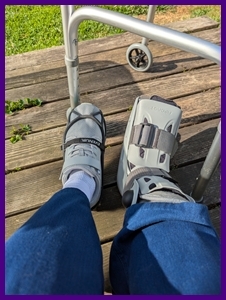
Currently, I am wearing one of those Star Wars-looking orthopedic boots on my right leg and a lift contraption on my right shoe to level out the length of my legs to enable walking. Yeah, right. It’s like trying to walk with a shoe box on each foot. So I have to use a walker to keep upright.

I have spent the past four months pretty much homebound with my foot elevated and my daughter taking on the exhausting role of caregiver — giving me my meals, my meds, and whatever access to the outside world that I need to have, including trips to the doctors and careful forays onto the deck in the backyard (weather permitting).

I can’t help looking at this as the beginning of the end, because from now on, it’s only going to be one thing after the other, as my assorted healers keep track of my chronic kidney disease, the damage to my digestive system, and the need for pain management of my back and knee.

In the past, I never thought about how long I might live, since my life was always filled with distractions from hard realities — fun hobbies, good friends, and variety of other interests. Now I often think about dying — when, how, why — and whether I’ll ever again have a compelling reason to keep the end at bay.

Right now, it’s like I barely exist on any kind of meaningful level.

Back in the old Blogger days, many of those folks made the point that blogging was a way to write themselves into existence.

So here I am, again, attempting to write myself back into existence, trying to find a point to it all, after all. Hoping to find a desire for desire.

I Concur with Judith Viorst

I just picked up from the library, two humor books by Judith Viorst, who is 93 years old. The two books are Unexpectedly Eighty and Nearing Ninety. Since she has had a long marriage to her husband, is financially affluent, and has a slew of grandkids, I don’t resonate with many of her pieces. But there are two that caught my attention.

From Unexpectedly Eighty, “Been There, Done That”:

When I see a young woman strolling down the street
With her gleaming hair, glowing skin, and impeccable thighs,
Evoking from the passing male population
Some appreciative glances, some longing sighs,
Some politically incorrect but rave reviews,
And when I notice that none of these fellows is taking notice of me
In my elasticized-waistband pants and my comfortable shoes,
I mobilize the wisdom of a lifetime
And tell my envious heart, Been there, done that,
Calling upon my memory’s rich store,
To which my envious heart replies,
Recalcitrantly, unreasonably,
But I want to be there again
And do that some more.

And, from Nearing Ninety, “Answers”:

I do not believe in God,
But if I did,
I might be thinking he’s not such a lovely person,
Considering all of the misery and injustice in this world,
Some of which (volcanoes and earthquakes, for instance),
Cannot, in spite of free will including
Our freedom to screw things up,
Be blamed on us.
Furthermore, I do not believe in an Afterlife,
With an upstairs and downstairs for the naughty and nice,
Our room arrangements made by a Higher Authority
Whose job it has been to scare us into behaving ourselves.
On the other hand, I do believe in Mystery,
And in my inability to fathom
How the world came into being,
How life began,
And, if there is a point,
To the point of it all.
So, if you are looking for answers from this old lady,
You won’t find them here.

The Truth About Aging

My thoughts on the challenges of aging bubble up after having read two pieces on the subject: the book Turning: The Magic and Mystery of More Days, written by a woman in her early 60s, and an article in The New Yorker, “Why We Can’t Tell the Truth About Aging”.

The book Turnings is a well-written conversation about how to prepare to enjoy getting older. It’s a great book to use as a stimulus for discussion, since it offers engaging exercises to examine what aging might have to offer you. But it is written by someone who has not yet experienced the realities of being truly “old”.

The New Yorker article, however, confronts the realities of aging with disturbing but necessary forthrightness.

There is, of course, a chance that you may be happier at eighty than you were at twenty or forty, but you’re going to feel much worse. I know this because two recent books provide a sobering look at what happens to the human body as the years pile up. Elizabeth Blackburn and Elissa Epel’s “The Telomere Effect: Living Younger, Healthier, Longer” and Sue Armstrong’s “Borrowed Time: The Science of How and Why We Age” describe what is essentially a messy business.

The so-called epigenetic clock shows our DNA getting gummed up, age-related mitochondrial mutations reducing the cells’ ability to generate energy, and our immune system slowly growing less efficient. Bones weaken, eyes strain, hearts flag. Bladders empty too often, bowels not often enough, and toxic proteins build up in the brain to form the plaque and the spaghetti-like tangles that are associated with Alzheimer’s disease. Not surprisingly, sixty-eight per cent of Medicare beneficiaries today have multiple chronic conditions. Not a lot of grace, force, or fascination in that.

A contented old age probably depends on what we were like before we became old. Vain, self-centered people will likely find aging less tolerable than those who seek meaning in life by helping others. And those fortunate enough to have lived a full and productive life may exit without undue regret. But if you’re someone who—oh, for the sake of argument—is unpleasantly surprised that people in their forties or fifties give you a seat on the bus, or that your doctors are forty years younger than you are, you just might resent time’s insistent drumbeat. Sure, there’s life in the old boy yet, but certain restrictions apply. The body—tired, aching, shrinking—now quite often embarrasses us. Many older men have to pee right after they pee, and many older women pee whenever they sneeze. Pipher and company might simply say “Gesundheit” and urge us on. Life, they insist, doesn’t necessarily get worse after seventy or eighty. But it does, you know.

When Socrates declared that philosophy is the practice of dying, he was saying that thought itself is shaped by mortality, and it’s because our existence is limited that we’re able to think past those limits. Time has us in its grip, and so we devise stories of an afterlife in which we exist unshackled by days and years and the decay they represent. But where does that get us, beyond the vague suspicion that immortality—at least in the shape of the vengeful Yahweh or the spiteful Greek and Roman gods—is no guarantee of wisdom? Then again, if you’re the sort of person who sees the glass as one-eighth full rather than seven-eighths empty, you might not worry about such matters. Instead, you’ll greet each new day with gratitude, despite coughing up phlegm and tossing down a dozen pills.

The one way to prepare for the challenges of being old is to develop a sense of humor that can help take the edge off stark reality. Judith Viorst’s book Unexpectedly Eighty seems to do just that. I haven’t read it yet, but I plan to. As I prepare for another gastroenterology test, I could use a good laugh.

I found MY “happy pill”!

I’ve been on antidepressants on and off during most of my adult life. They would keep from getting too negative, but they never really helped me feel much better.

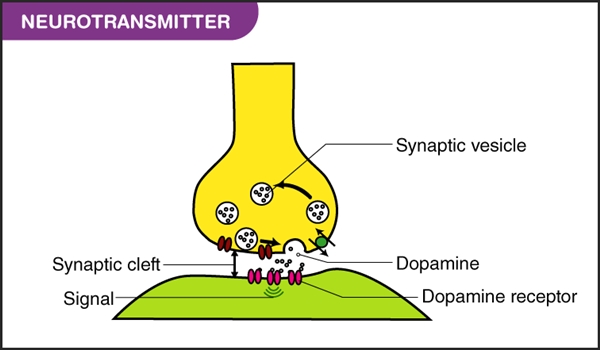
That’s because most prescribed antidepressants are “serotonin agonists”. Serotonin is one of the chemicals produced by the brain’s neurotransmitters that calms anxiety and keeps you from feeling negative and defeatist. A “serotonin agonist” is a substance that mimics the serotonin that your synapses are releasing to add to their effectiveness in instances when they have slowed down. (That is only a layperson’s simplistic description; I am not a doctor or scientist, but I’ve done a lot of reading about the process; a visual example is at the end of this post.)

It seems to me that, just as bodily functions cease to operate at maximum efficiency as we get older (and so we take statins and blood pressure meds etc.), the functions of the brain also slow down as we age. I posit that the lack of enough serotonin available to the aged brain can be the cause of so much of the depression we see in the elderly.

Now, not being depressed is not the same as feeling content and happy. I have discovered, for my purposes, that there is a pill for that.

One of the other chemicals produced by the brain’s neurotransmitters is dopamine, which plays a role in motivation and reward-seeking behavior. And that’s the happy pill: a “dopamine agonist” that helps the neurotransmitters and synapses create the dopamine necessary to have a positive effect on mood.

Now, why aren’t both serotonin agonists and dopamine agonists prescribed together? Actually, only recently, prescriptions like Abilify, which only partially deal with dopamine, are available. But they didn’t really work for me.

So now I take one serotonin agonist and one dopamine agonist.

And now I’m writing more, launched a national petition to improve senior housing,  just organized a Drum Circle at my senior center, and took on a project to write an interview of the author of Turning: The Magic and Mystery of More Days

As promised, here’s a visual of how neurotransmitters work, using dopamine as an example:


Wiser Than Me

Julia Louis Dreyfus is doing a podcast called “Wiser Than Me”, interviewing elder women about their lives and their attitudes toward aging.

After unclenching my teeth over the grammatical error in the title (the correct wording is “wiser than I”), I tuned in to the first two sessions with Jane Fonda and Isabel Allende.  The secret to having a successful “old age”, according to those octogenarians, has to do with good health and enough money.  Duh. Aren’t those things at the basis of every comfortable life, no matter what your age?

What has enabled these two women to truly enjoy this final chapter of their lives is their passion for what they love to do.  For Fonda, it’s activism and acting;  for Allende it’s writing and her recent remarriage.

Fonda has opted to live alone, deciding that she would rather not have to be nude in front of anyone at this point in her life.  She has let her hair go gray and wishes that she had not opted to go the plastic surgery route. Her friendship with women is most important to her at this stage of her life, as is her activism on behalf of saving the planet from fossil fuels and other pollutants.

Allende, on the other hand, is still comfortable with her sexuality (she remarried three years ago) and spends most of her time writing, which is her passion and purpose.  She says that she writes because she has to and loves the process.

Both consider themselves feminists and live their creative lives with that as an underlying philosophy.

Listening to these two women talk about their lives, past and current, I envy their passion and purpose.  Somewhere during the pandemic, I lost touch with mine, and I’m still floundering around, trying to recreate myself.  Maybe I can get inspired by continuing to listen to these podcasting women, who are so much wiser than I am.


Blooming Bulbs and Other Spring Things

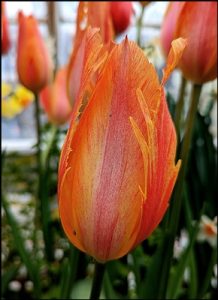
Ballerina Tulip

This is a Ballerina Tulip, one of the stunning blooms at the Botanic Garden at Mt. Holyoke Collage, where David and I spend Sunday afternoon.  (Upside down, it looks like a ballerina’s skirt.)

I was hoping that there would be some calla lilies, but there was only one lone white one stuck in the corner of the Medicinal Plant section.  Apparently, The underground stem of the calla lily was used as a medical treatment for dressing wounds in South Africa.

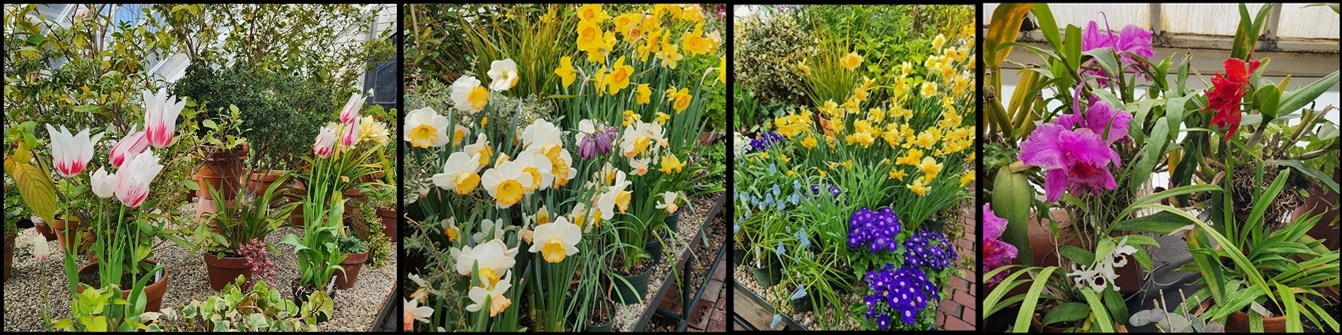
But other blooms abounded, with all kinds of tulips, daffodils. hyacinths, and myriad other plants labeled with their scientific names. I wished that they had also included their common names so that I could actually identify them.

Two of the medicinal plants that were included were Ayahauasca and Peyote.  The  exhibit featured a large Ayahauasca plant, but the Peyote was nowhere to be found.  We wondered if someone stole it.

I noticed that there were no cannabis plants and I wondered why.  I never thought to ask, unless it’s not considered medicinal?

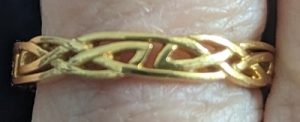
Spring is a time to celebrate new beginnings, so on our birthdays (March11 and March 12; we we born exactly 36 hours apart), David and I exchanged commitment rings.  I have not worn a gold band for more than 40 years, so it was a major decision for me.

At age 83, we are both at the same stage of our lives, and while we have different histories, we have arrived at the same place — physically, psychologically, emotionally. It’s all good.

Today, at 5:24 pm is the Spring Equinox.  We are all eager for Spring to arrive in full force, especially after the most recent Nor’easter, which dumped about 18 inches of snow up in the hill towns where David lives.  He is trying to find a place to live closer to me, but it’s a challenge, for all kinds of reasons.  But we will figure it out, together.

GOING…GOING………………..

The other night I dreamed of my best friend and roommate in college (from 1959-61). The last time I spoke to her on the phone, probably 7 or 8 years ago, she was living in an Assisted Living place while her husband, afflicted with Parkinson’s, was in the Memory Loss Unit. She was furious because her children had taken away her car and license.

When I “googled” her today, I found her obituary. She died in 2021, “peacefully”, it said, and suggested contributions to the Alzheimer Association.

In our Junior year, we shared a room in the sorority house with two other girls. This is three of us in 1959.
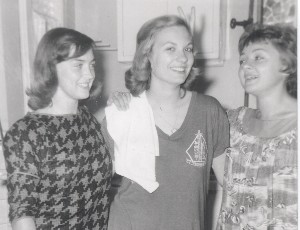
Shirley, Carole, and me.

I (on the right) am the only one of us three who is still alive.

Here are the four of us at our reunion in 2004. Shirley and Carole, in the middle, are both gone. Cathy married a guy with whom I loved to dance.  He had great style and knew how to lead.  Cathy has been a widow for the past 4 years.
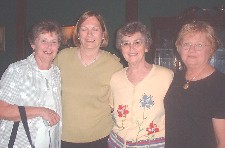
Cathy, Carole, Shirley, and me.

Shirley and I shared our clothes and countless adventures during our college years. We wore the same size clothing, and I was more than happy to wear her comfortable, casual outfits, while she wore many of the dresses and skirt-sweater sets with which my family saddled me each year. Another difference between us was that I wore lots of makeup and she wore none. And while she was a Business major with a very linear and logical mind, I was an English major who fantasized about moving to San Francisco to write poetry and live in a garret. We also had different taste in boyfriends, so we were never in competition with each other. I don’t think we ever had an argument, unless you count the time my roommates got fed up with my messiness and took all of my stuff that was lying around, wrapped it all in my blanket, and threw it in the closet.

Shirley taught me to drive while she was taking the college class to get certified to teach Drivers’ Ed.  She had a car, and I was 19 years old and had never learned.

Shirley’s and my greatest adventure was heading out to Daytona Beach during the spring of ‘59 for Spring Break. We drove straight through from Albany, NY to Daytona in a little blue coupe with three guys we knew. I think it was Chuck Recesso’s car, and he did most of the driving. One of the other guys was Frank Fallace, but I can’t remember the name of the third, although I can picture his face and could probably find him in the yearbook. I remember the drive through the South and the signs in the places we stopped for both ingesting and eliminating food that boasted signs of “coloreds not allowed.” We were liberal Northerners, and were taken aback by the reality.

While the guys were probably assuming that we would hang out with them, Shirley and I had other plans, since she had male friends from Cortland State College who were also planning to be there.

I don’t remember much of our time in Daytona, but I remember that the water was filled with Portuguese Man-of-War fish, and that we partied hard (still vehemently protecting our virginities, of course) and finally wound up booking flights to come home, avoiding the stifling car ride back– 17 hrs (1,157.2 mi).

We each married in June of 1961, but our lives went in totally different directions. Shirley married the handsome and sweet Owen Davis, teaching business subjects at a community college, and boasting three children and, finally, several grandchildren.

The last time I saw her and her husband was about 15 years ago, when I met them one Fall, down in the Catskills, for an apple festival. Owen was already showing signs of the Parkinson’s disease that finally ended his life; but he was still handsome and sweet. I wish that I had kept in better touch with her, but, you know…..LIFE!

And this is the way it will go from now on.  Because, you know….LIFE!
 

Getting Back in the Personal Blog Saddle

More than 20 years ago, my son, Bix (who is autistic but didn’t know it back then) got me into blogging.  The personal connections that I made back then helped to get me through some rough caregiving years.  We all posted every day, whatever was on our minds at the moment — politics, culture, health, family, mutual support, cats. We commented on each other’s posts and kept conversations going. We were a real community; we got to know each other pretty well.  Some of us even found a way to meet in person, but even those of us who never did, still developed real friendships.

But, times change, priorities change, culture changes. Life happens.

My last post pretty much explains why I have been otherwise occupied.  I am on my last great adventure — the adult love affair of my life.  At 82.  It has it’s challenges, especially since we live an hour away and each of us lives with our daughters.  But we are figuring it out, together.

Now that we are past the Solstice and into a new year, I’m going to make an effort to post more often.  There are still things I care about, struggles I and others are going through.  Maybe there will be a way to slowly build another blogging community, but even if not, I will again follow the example of my son and get my blogging hat back on and see where it goes.

One of the things that has gotten my brain interested in writing again was a request from my daughter to write my story for my grandson, Lex.  The request actually came as a gift last Christmas from Storyworth.com, which provided a question every day that I could answer, with the idea that it would all be printed into a book at the end.  I opted just to start telling my story (I just finally started), and I have until January 16 to finish it.

My circadian sleep disorder is still not under control.   Medical marijuana usually helps.  I manage it the best I can.

And so it goes.


Getting Nowhere, Fast

How bad do I have to get, mentally, to get help?  Now I am bouncing off the walls in some kind of manic episode.(Not the first one, as of late.)  My daughter thinks that I am getting to be bi-polar — or maybe I have been all of this time but have been able to manage it.  But now it is all out of control.  We are still looking, but I am getting very discouraged.  I need to find someone who will both do therapy with me and help me manage my meds.

I’ll bet you didn’t know that I’ve really been crazy for all of these years.

If you read this and have any knowledge of available psychologists or psychiatric nurse practitioners who are still accepting new patients, please let me know.

I want to go to sleep and never wake up. (Don’t worry, I won’t do anything about that; it’s just how I’m feeling).