Alone, alone, all, all alone

The title of the post is from The Rime of the Ancient Mariner. It resonates with me these days, mostly because of the COVID pandemic and my choice to limit my contact with the outside world.

Combine that with the dark early morning hours when I am alone because of my DSPD, along with the upheaval in this house as my daughter and grandson focus on training their new dog while trying to accommodate the existing prissy cat, who wants none of it. She doesn’t like me, this cat. Never has, and nothing I try to do changes her mind.

I miss the touch of a living creature. My own old cat died about 8 years ago. It wasn’t a great life for her here; she was confined to my two rooms because she attacked the two other cats that lived in this house at the time, and she refused to develop even a tolerance of them. And they were here first.

I live in a house, but it’s not my house. There is a cat who lives in this house, but she is not my cat. There is a new dog who lives in this house, but he’s not my dog.

I am grateful that my daughter and family welcomed me to live with them as I advance in age. It was my best alternative.

But I miss the soft purring on my shoulder, the silky fur brushing my forehead, the rough tongue licking my cheek.

I miss not being alone.

So, here I am at 2 A.M……

While I’m waiting for that “sleep switch” to kick in, I’ve been trying to track down other bloggers around my age to see if we can develop into a virtual community of kindred spirits. That’s what I had back in the 2000s, and I miss the virtual camaraderie.

As part of my efforts to lesson my feelings of isolation, I am working with my local senior center to try to put together a weekly Zoom group of older folks who are disabled or are self quarantined. I only go out when I have to — medical appointments or grocery shopping. I would love to make new friends, and these days, Zoom is the way to do it.

I did spend most of my afternoon sending out my poetry in response to several “call for entries.” I have been pretty successful getting my poetry published, but it is three years since I have sent any out. At some point I will add a “Poetry” link to my primary menu.

Beginning next week, I will be part of a Zoom-based poetry group. I just love when synchronicities kick in and I become aware of the ongoing spirals that my life is on. I dreamed of a married couple with whom I was close friends for decades, but then they moved away. I contacted to tell them about the dream, and they put me in touch with the leader of the poetry group. The leader of the poetry group was one of my ex-husband’s college students and my daughter was a flower girl at his wedding. Circles into spirals.

Obviously, I have my depression under control. If only I could do that about my Delayed Sleep Phase Disorder.

Three or four a.m. has become my usual bedtime. Will I ever be awake again during those morning hours when the air smells fresh and the birds are just starting to sing?

It’s Not Insomnia, It’s DSPS

I don’t have insomnia, I have Delayed Sleep Phase Syndrome.

Over the past decade, I consulted with various sleep specialists, none of whom ever mentioned DSPS as a diagnosis. I finally had to diagnose myself. All of them told me that I, indeed, had a sleep disorder and provided various suggestions, all of which I tried and documented here. The last sleep study I endured, several months ago, required two Ambien to even get me to sleep on their schedule. Then they woke me up after 4 hours (5 am) because I had to leave, and I was barely able to walk out of the lab and find a place to sit and wait for my daughter to pick me up. I have found that few doctors do the investigations necessary to actually find an accurate diagnosis. It has become cookie-cutter medicine. One size fits most.

Three months ago, I had a serious emotional meltdown, which prompted me to find someone to prescribe more effective anti-depressants, since there would be days I would only get out of bed to eat and go to the bathroom. Struggling to change my circadian rhythm — and failing over and over — finally sent me on an internet search to see if my 3 or 4 am to noon or later sleep schedule was something others were experiencing. And they are. Many. All of the world. Almost all just learned to live with it because nothing worked when they tried to change it. One woman who lived on the east coast took a job on the west coast because she figured that would put her bedtime at midnight, and she could live with that. But it didn’t take long for her body to relapse back to a 3 am bedtime, even on the west coast.

This household shuts down around 11 pm each night. That leaves me with a good four hours to find something to do that won’t wake them up. It’s so easy to just sit, watch tv or read, and eat. I wish I could use that time to write poetry.

Anti-depressants, at the potency at which I am now consuming them, dull the sensibilities that I need to be inspired to create poetry. Even my prose becomes drab and spiritless. But now that I have a diagnosis and an actual official name for what I am experiencing, I will try to ease off some of what I began taking to climb out of the Major Depressive Disorder that I fell into because of all of my failed efforts to change my circadian rhythm.

What I wonder is, why now, since most folks with DSPS are adolescents or young adults. I think there’s a connection to the 5 year trauma I lived through taking care of my increasingly demented mother while dealing with the constant harassment and abuse heaped upon me by my brother. During that time I had no set sleep schedule and often had to resort to sleeping pills to get any rest at all. While enduring my recent meltdown, I realized that I really do have PTSD as a result. Knowing is always better than not knowing.

I’m back writing on this blog to fill up some of that time until 3 or 4 am, when my sleep switch activates. That’s really what it feels like. While I feel relaxed and tired during those wee morning hours, there comes a time when I simply fall asleep, as though a switch is flicked. There is nothing I can do to make that happen. When my brain is ready, it shuts off. And then I sleep deeply for 8 or 9 hours and wake up rested.

So, this is my life now, at age 81. It could be worse, and I try to be grateful that I can still see and hear (with help) and drive (but not at night) and I don’t have any serious medical conditions. I can live with that.

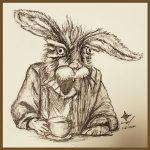
Mad as the March Hare

It’s March. Lost, mindless Oestre chicks. Hares gone Mad with abandon.

March Madness is a crazy time, a neither/nor time. Neither winter nor spring. An in-between time. Neither asleep nor awake.

Mad March targets the tales of those who hide behind the shroud of surety and secrets, takes hold of souls wrapped in remnants of reason, sending them into the mad March wind, freeing the poet’s wonder to unseat what is mean, what is mad, what is best left to the whinings of past seasons gone to seed. Beware the March Hare, unless she is your cup of tea.

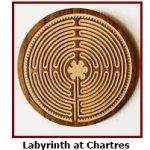
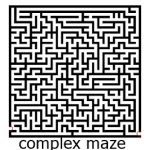
A Labyrinth is Not a Maze.

From here:

A maze is a complex branching (multicursal) puzzle that includes choices of path and direction, may have multiple entrances and exits, and dead ends. A labyrinth is unicursal i.e. has only a single, non-branching path, which leads to the center then back out the same way, with only one entry/exit point.

These two structures have different, although related, meanings. Yet they are incorrectly used interchangeably all of the time

A labyrinth, while sometimes having very convoluted-seeming pathways, really only has one way in and one way out. Walking a labyrinth invites patience, focus, care, introspection. The goal is not to find your way out or in. That’s all laid out for you. You can’t get lost.

There is no set ritual for walking a labyrinth, but there are books and lectures to assist you in performing a labyrinth walk. The basic advice is to enter the labyrinth slowly, calming and clearing your mind. This may be done by repeating a prayer or chant.

A maze, on the other hand, invites you on a challenging journey to find your way in and your way out. Its pathways are meant to be disorienting and its goal is to confuse you. According to Wikipedia:

A maze is a path or collection of paths, typically from an entrance to a goal. The word is used to refer both to branching tour puzzles through which the solver must find a route, and to simpler non-branching (“unicursal”) patterns that lead unambiguously through a convoluted layout to a goal. (The term “labyrinth” is generally synonymous with “maze”, but can also connote specifically a unicursal pattern.[1]) The pathways and walls in a maze are typically fixed, but puzzles in which the walls and paths can change during the game are also categorized as mazes or tour puzzles.

The Minator lived in the middle of a MAZE – a maze with such complex pathways that Theseus, sent to kill the monster, might not have been able to find his way out after he completed his task. So he tied a ball of string to the entrance to the maze and unwound the string as he went in so that he could follow it back and be able to get out.

So, while a labyrinth can be classified as a “maze,” a maze is not the same as a labyrinth.

This is what I was thinking about the other night, waiting for sleep. (Sleep doesn’t come easily or me).

I am thinking that some folks seem able to walk the safe, set pathway of the labyrinth life-model. Some by choice, like cloistered nuns and monks, who are relieved of the kinds of personal choices that are constantly confronted by those who find themselves navigating various stressful life mazes. Others, because of personality traits or very careful controlled planning, find their lives moving within the ease of the Labyrinth. There are still others who allow themselves to be absorbed into a cult mentality that provides the boundaries and makes their choices for them, making hard life choices simply by giving them a labyrinthian framework to follow. If they don’t deviate, they will make it to the goal (however the cult defines it). Organized religion also provides that clear pathway, so much easier to navigate than that messy maze.

Most of us, however, can’t avoid the stresses from the constant choices with which we are confronted along the maze-like journey of our lives. We constantly bump into dead ends, go around in circles, sometimes just sit down wherever we are, too tired to go on. I also think that if you are a creative person who engages with life to find inspiration, motivation, questions and answers, you have no choice but to take your chances in those messy mazes.

Like a Stone Labyrinth

Life leads you.

You set your alarm,
choose your shoes,
gather friends for tea,
count your changes.

Until one day a corner comes,
slipping you a glimpse
of that line of stones
shaping your shadow’s edge.

And then a perfect black cat,
with eyes like glowing stones,
races across your path
and waits in the early ferns
for you to cross hers.

“to sleep, perchance to dream”

Yes, that’s from Shakespeare.

Boy, am I doing a lot of sleeping and dreaming. As a matter of fact, my dreams are a hell of a lot more engaging than my life these days. It gets so I don’t want to get out of bed, because if I stay there and fall back to sleep, I will have more adventurous dreams that are more interesting than any of my daily doings.

My dream world has very specific landscapes that include a section that is some odd representation of the campus where I went to college; a distorted version of the part of the city where I worked for 20 years; a kind of Catskill Mountain vacation hotel where I once attended ballroom dance weekends; and a weird version of an apartment complex where I used to live. I am always trying to get somewhere among those places, but it’s usually a matter of “you can’t there from here”. On those excursions, however, I might meet up with friends, go dancing, play with cats, and come up with a good first line for a poem. But then I wake up, and it’s all gone where dreams go.

No matter how hard I try I can’t reclaim a normal sleep schedule. I often don’t fall asleep until early morning hours, and then I sleep until afternoon. My sleep got messed up more than a decade ago when I was taking care of my demented mother. A search of this blog for “caregiving” or “dementia” will unearth full details.

I have tried to get control of my insomnia (search “insomnia” if you are curious). Medical Marijuana worksto get me to fall asleep, but it is awfully expensive because it takes a double dose to have any effect on me.

There actually have been more than a couple of times when I didn’t get out of bed for more than 24 hours. To be honest, I there are times that I would just as soon not wake up. I kind of identify with a 1999 episode of Ally McBeal, in which “Ally’s favorite teacher from high school is dying, but she has a wonderful dream life which she would like to remain in. Ally decides to get a court order to force the hospital to put her into a coma.”

In my dreams, I have relationships, friends, hugs, interactions, adventures — kind of the opposite of life with Covid-19. (I do live with family, but that’s not the same as hanging out with peers.)

On the Late Show last night, Bill Gates suggested that it might be close to a couple of years before we can settle into some kind of normalcy. How are we all going to keep from going off the deep end before then? Will I even live long enough to see a “new normal.”

In the meanwhile, lacking motivation, energy, and inspiration, I continue to avoid my pile of half-done creative projects that are wasting away in the corner where I piled them months ago. And, also in the meanwhile, I have tracked down a former therapist and have started, again, trying to find my muse, looking for some fuse that will propel me out of this mindless funk.

“…everybody hurts…”

It’s a gloomy Monday and everything hurts. REM’s song has become an ear worm.

When your day is long
And the night, the night is yours alone
When you’re sure you’ve had enough
Of this life, well hang on

Don’t let yourself go
‘Cause everybody cries
Everybody hurts sometimes

Sometimes everything is wrong
Now it’s time to sing along

When your day is night alone (hold on, hold on)
If you feel like letting go (hold on)
If you think you’ve had too much
Of this life, well hang on

‘Cause everybody hurts
Take comfort in your friends
Everybody hurts

Don’t throw your hand, oh no
Don’t throw your hand
If you feel like you’re alone
No, no, no, you are not alone

If you’re on your own in this life
The days and nights are long
When you think you’ve had too much
Of this life to hang on

Well, everybody hurts sometimes
Everybody cries
Everybody hurts, sometimes
And everybody hurts sometimes

So hold on, hold on
Hold on, hold on, hold on

Everybody hurts

I dream #1

Last night I dreamed I was driving fast in a small stick-shift car, and I didn’t have enough leg room. I have only driven a stick-shift car once, decades ago. I don’t remember where I was going or why, and it was dicey going. Well, there you go.

Do Not Go Gentle

Dylan Thomas wrote the poem that begins “Do not go gentle into that good night.” It’s very easy to fade away into old age, to pretend all is OK, to try not to be a burden, to keep our pain and sadness to ourselves. I guess it’s one thing if you are old and terrifically healthy and still run marathons and such. It’s another if your bones acknowledge the wear of every year — and that is the situation with most of us.

Most younger folks have no idea what they might be in for because we often try to accommodate to their expectations of us. Well, I say that we need to own — and own up — to whatever fragilities we have earned. Let the rest of the world become more aware of what the realities of aging are for most of us. Maybe then they would be more patient when we drive more slowly, or take longer at the check-out lines, or struggle with hearing loss.

I refuse to pretend that I don’t need help getting up and down stairs or getting out of a chair, or opening a jar of pickles. For sure, getting in and out of a car.

My family, with whom I live, understands my struggles because I don’t hide them. My reality is not very gentle: my gait isn’t always steady, my fingers don’t always hold sure, my rest isn’t always enough. And I think that is the reality for most of us, and it is a reality that most of those who are still young will one day face. They might as well see it coming.

So I believe in complaining — in the sense of being honest about what it is like, for most of us, to be old. We should be brutally honest, rather than gentle, about admitting — as Bette Davis supposedly admitted — “Old age is not for sissies.”

This is what I think about as I lay, sleepless at 3 a.m.

But I think of other things too — the projects I would like to do if I could find the energy and focus, for example. I am realizing that most of my life has required a great deal of both, and I have always had to move fast, decide quickly, shift gears while still in full-speed mode. I never had much patience for long-term planning (not a good thing); I’ve never had expectations of perfection (a good thing). But I always had the energy and focus to get done what had to be done.

Now, I spend an awful lot of time sitting in my rocker/recliner, staring into space, not thinking, or planning, or hoping. I spend an awful lot of time awake when I shouldn’t be and sleeping when I should be living.

Life with Covid-19 sucks, and it sucks even more if you are physically feeling your old age, isolated from your peers, and disconnected from outside stimulation. Yes, that’s how I feel, and I have to believe that I am not alone.

There was a time in the history of this weblog that talking to myself, here on these pages, got me through some rough times because there were folks out there eavesdropping with whom I eventually connected in a reaction of mutual support and camaraderie. That connection was the whole purpose of personal blogs, back then.

But it’s a different virtual world, now, and if all I do is talk to myself in these pages, that’s fine. I learn a lot about myself that way, and, although what I learn is not always pleasant, it’s enlightening.

“Too soon old; too late smart”.

Or as my Polish grandmother used to say “starość nie radość”.
Shifting Blog Gears

This box marks the end and the beginning. What follows below this post is who I was. What precedes it is who I am and will be. With the Covid-19 Pandemic, with my achieving octoganarianism, came a sea-change, and this blog will reflect my life yet to be lived, as I persist.