Remembering my mom, who passed away just about this time of the evening one year ago today.
One Year
1
Remembering my mom, who passed away just about this time of the evening one year ago today.
From Last Acts of Kindness: Lessons for the Living from the Bedsides of the Dying, by Edith Redwing Keyssar.
I have a unique relationship with death. My father was an undertaker, and we lived in an apartment above his business. Contemplating death and dying — my own and others’ — has been a part of my life since childhood. I have sat vigil during the hours and days of the deaths of both of my parents. At the age of 71, I am closing in on my final years. I have no control over when or why I will die; but I am learning about the choices I have about “how”.
After leaving a comment on a post on Time Goes By about Judith Redwing Keyssar’s book (quoted above), I have had a chance to read that book myself. And, doing so comes at a particularly relevant time in my life as I await my first assignment as a hospice volunteer.
During the intense training that I had to undergo, I learned about my role and responsibilities as part of a hospice team and examined my reasons for choosing this kind of volunteer service. I found that the experiences that Keyssar shares in her book take whatever personal motivations I have for becoming — in her words –“a midwife to the dying” and draws them into an even greater context of compassionate and cosmic significance. As part of her stories, Keyssar reiterates the point that it doesn’t matter what one believe about an “after-life;” the focus of her message is to live fully while embracing the fact that we, after all, are all “terminal.”
At the end of her book, she provides a list definitions, internet links, and bibliographical references if the reader chooses to further explore the range of information available about compassionate care during the final stages of life.
The final chapter in Keyssar’s book is a poetic Epilogue (see below) that captures the intent and the spirit of the mission of those who choose to honor and celebrate the final, fleeting days (and sometimes months and years) of a human life by becoming part of a palliative care and/or hospice team.
Epilogue
Job description For Any Member of a Palliative Care TeamI am here to witness
the sacred hearts
broken open.
Friends,lovers, families
whose loved ones die in their arms,
in the homes, in their beds, in hospitals or other places.
Peacefully, nor not.I am her to witness
the sanctity of human life
as the spirit is released from the temple
to join once again, with the invisible cellular infinity
of the Universe,
the mitochondria of the Milky Way,
becoming energy to light the stars,
since we know —
the energy we manifest as a particular human being,
like any other,
can neither be created
nor destroyed.
God, by any other name by any name, by many names,
by no name,
Is
One.I am here to witness
the breath
as it enters the body
and exits for the last time.
The miracle of birth.
The miracle of death.
The miracle of each moment in between:
Life
the infusing of consciousness
into each and every cell
enduring every moment
we are here
on earth.I am here to witness
to feel
to experience
to honor
to know that Love is eternal.
to share this blessing
in gratitude.and to perform any other duties
required.
Last Acts of Kindness is a book that should be read by everyone who expects some day to die.
As I was writing this post, today Ronni Bennett at Times Goes By posted another piece that includes additional thoughts on death and dying. The conversation continues.
The following is my response to the visual prompt of Magpie Tales #57. The responses of other writers are linked from the site.

would that the luck of the Irish
turn heated rain to shamrocks
that burst to pots of gold
where they fell —
pots of gold and violets
to pay for hope
and promise a fertile
future
It’s March 11, 2011.
There was a terrible earthquake in Pacific Ocean today, and Japan is being hit with 30 foot waves. Tsunamis of various sizes are headed toward both North and South America. Untold lives are being destroyed even as I write this.
Rebellion and unrest in the Middle East and Africa continues to escalate, as untold lives are being destroyed even as I write this.
The state of Wisconsin is leading the way toward an America I’m not going to want to live in, and untold lives are being destroyed even as I write this.
It is my 71st birthday today, and, as I watch and listen to the devastating events going on all around me, I am grateful for the life I have right now, uneventful ‘tho it often is.
And that’s why today, on my 71st birthday, I am filling out forms to be a hospice volunteer — because I am used to doing useful things and need to do something useful with the time I have left.
When I moved here to be with my daughter and family two years ago — after almost a decade of care-giving and 40 years of various other “useful” jobs — I thought that I would be happy hanging-out, relaxing, reading, doing my crafts, gabbing with my daughter, playing with my grandson.
Well, I’ve been doing that for two years, and now I’m ready to get on with some kind of more useful life.
There are about five nursing homes in my immediate area, all of which have hospice units. I’ve been on the receiving end of hospice services as a family member through both my dad’s and mom’s illnesses. I know, from experience, what kind of support people in that situation need. And, since I was an undertaker’s daughter, death has been a part of my life since I was born. It is as though I am coming full circle.
I’m not doing this for altruistic reasons. My reasons are rather selfish. I need to interact with and meet other people (and I discovered that the gym and senior citizen center are just not my style); I need to do something useful.
And that “usefulness” might even spill over to my creative crafting, since I would be interested in making the kind of “memory pillow” that I made for my mother for others who might find them comforting.
So, at 71 I’m shifting gears yet another time so that my time here has meaning for me. My mother lived until she was 94. I don’t know if I’ll last that long, but, while I’m here, I want to be engaged with the world in a more meaningful way.
For my birthday dinner, my daughter is making my favorites: shrimp scampi and key lime cheesecake.
It’s my 71st birthday, and, even as I write this, my life is good. But as I watch the news on CNN, I wonder — for how long?
Your eight-year old can’t go to sleep because he’s crying so hard. He’s crying so hard because, he says, he doesn’t want to ever die and he doesn’t want anyone he knows to ever die because he doesn’t want to be alone.
You don’t really believe in “God,” and don’t believe in heaven. You’re not religious, and the Golden Rule is about the closest you come to embracing any doctrine, although you try to pass along a moral and ethical code that you hope he understands and continues to live by.
But what about “after?” What about after this life? What do you tell your eight-year old that will calm his fears without outright lying?
What you do is write a book that explains who and what we are in a way that will address his fears yet still be in the realm of what might actually and scientifically happen. ( After all, Carl Sagan thought so.)
And you call this book Spark.

Go over online and read through Spark — and see if it’s the answer you’re looking for.
This is my response to Magpie Tales’ visual writing prompt #42. You can find the responses of others by going here.
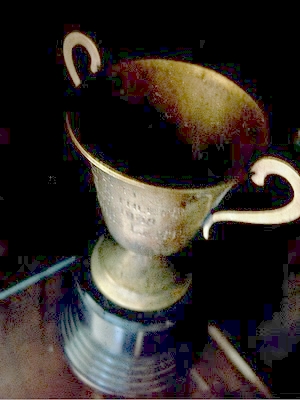
The Chalice of Pain
Pain. We all feel pain. We all would rather not feel pain, and those in pain usually can let you know where it hurts and how badly it hurts.
Except if they have dementia.
There is a false assumption that those with dementia don’t feel pain because they often can’t articulate that fact in ways that are obvious — especially with words.
From “Pain and Dementia,” referenced above:
Over time your family member may lose the ability to speak or may not make sense when they do. Therefore, it is very important to be able to recognize behaviours or actions that indicate pain. Some of these pain-related behaviours include the following:
* frowning, grimacing, crying
* swearing, moaning, calling out, noisy breathing
* fidgeting, pacing, rigid posture
* guarding an area of their body, not wanting to move
* hitting or striking out
* withdrawing or resisting when someone is helping with personal care
* refusing food
* change in appetite, rest periods, or sleep patterns
* increased confusion, crankiness, or distress
From “Behavioural Changes”:
* Sudden changes in behaviour are important to recognize as these are often the only clue that an older person is sick, getting worse in their dementia, becoming depressed, or having a side effect from a new medication.
* Attention to your family member’s behavioural and psychological symptoms are key to improving and maintaining their quality of life.
A recent PBS Frontline program, “Facing Death,” documented the pain suffered by both family (emotional pain) and those dying from dementia and other illnesses (both emotional and physical pain.) You can watch the program at the above link. Also of great insight are the comments left by viewers.
From “What happens when elderly people die?”
…fewer than one in five people can have a peaceful end, since ‘dying is a messy business’ for which relatives are unprepared. He continues: ‘Too often, patients and their families cherish expectations that cannot be met, with the result that death is made all the more difficult by frustration and disappointment with a medical community that may be able to do no better.’
Relatives who expect aware deaths may become angry and turn their anger onto doctors and nurses when death takes other forms. Dying people often need psychosocial support, but the potential for introducing this occurs only when the dying phase is identified. This is not always possible in trajectories 2 and 3….. [2) long-term disability with periodic exacerbations and unpredictable timing of death that characterize dying with chronic organ or system failures (some cancers that respond to treatment and then relapse come into this category); (3) self-care deficits and a slowly dwindling course to death from dementia.]
After watching the Frontline program and hearing how the doctors explain the options to the families of dying patients, it seems to me that there needs to be more honesty from the medical profession about the dying process, its inevitability, and the benefits to the dying of making those patients as pain-free as possible.
Maybe, because I grew up above a funeral parlor operated by my father, a funeral director – maybe, because I sat at my father’s bedside while it took days for him to die of cancer (his mind was alert and he chose to die at home with a certain amount of pain) – maybe because I survived the excruciating pain of a breech birth and thought I had died and now I’m not afraid to die – I feel strongly that, when death is close at hand, it should be welcomed as a relief from pain and that pain (for example, of old organs failing, of agitated dementia) should be aided by pain-relief medication.
On my bookshelf is “Final Exit,” which I bought a long time ago out of curiosity about peaceful “self-deliverance” when my time comes, especially if that time comes riddled with pain.
But it becomes a lot more complicated if a form of dementia has stolen my ability to communicate my pain and my wishes. My daughter knows that I’d rather die in peace than die in pain.
In the story of the Garden of Olives, even Jesus pleaded for the chalice of pain to be taken from him. No one wants pain, although we often are willing to bear with a certain amount of it if it’s going to get better. But the pain of dying does not get better.
Somehow we need to be educated about that fact so that we hold the best pain-free interests of our dying relatives in mind.
My mother’s name was really Bronislawa, which doesn’t have an English equivalent. So they called her Blanche.
Her dementia took over all of our lives for the past decade. Now that she is gone, my mind has cleared enough to remember her as she was before.
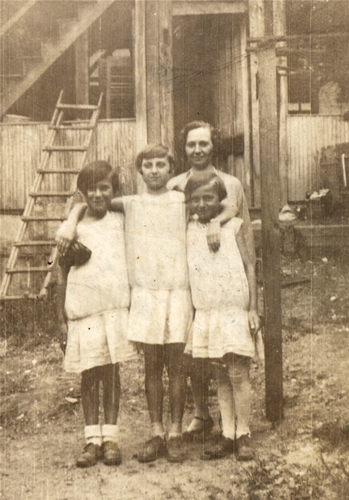
She was born in America but spent 8 years in Poland with her mother and siblings between the World Wars, when she was a pre-teen. Her father stayed behind to keep earning money, and the rest of the family went to live on the family farm in Poland. She was bi-lingual. She was the oldest of three sisters. She never graduated from high school. She had two brothers. None of her siblings is alive.
This is her and her mother and sisters when they returned from Poland to live in Yonkers.
At the age of 16, she went to work in the Alexander Smith and Sons carpet factory. Her family struggled financially, so they all had jobs. She often recalled that her father had to wrap her arms with ace-type bandages because they would be so sore after a day of work. Until the day she died, she had an indentation in her right forefinger, which she said was caused by the thread she had to wind around her finger day after day.
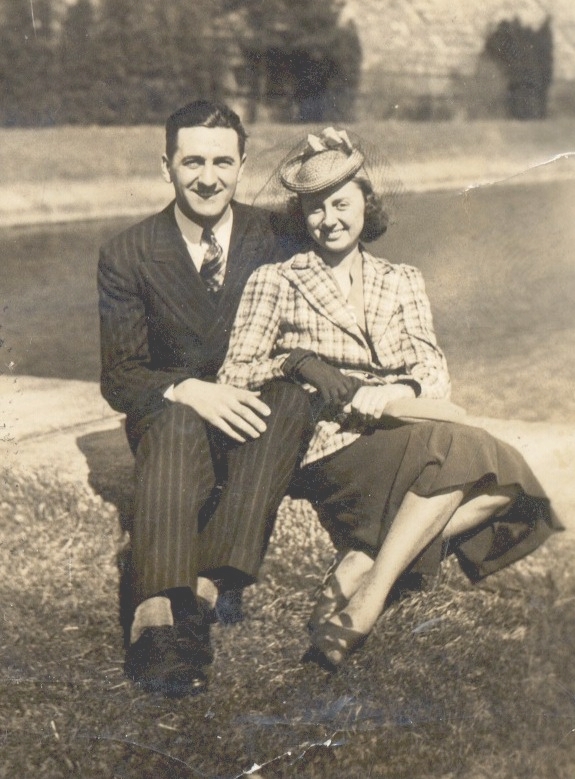
She was always slim and petite. And pretty. Not beautiful or striking. Pretty. He was handsome. “All the girls were after him,” she often said, “but he picked me.”
This is her and my dad when they got engaged.
She also was a great social dancer and, of course, loved to polka. For many years she danced in a local Polish dance troupe. That’s her, on the left, and one of her best friends, who is still alive and who attended her funeral.
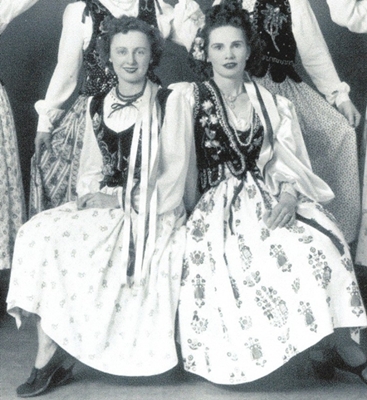
Even toward the end of her life, when she pretty much stopped speaking and walking, my mom would follow my lead in the fox trot and waltz if I held her close to me. She loved music. Loved to dance.
She also liked to sew. When I was a child, before every Christmas, all of my dolls would disappear for a day or two and then show up on Christmas Day all decked out in new dresses that my mother made for them. She liked her clothes to fit well, and she was always sewing them in, letting them out, hemming and correcting. I have that same tendency. She taught me to knit, crochet, and embroider, although she never really spent much time doing those things. Mostly, she was the full-time wife and mother and much-loved member of a group of Polish/American women who played Canasta once a week and socialized, family-style, other times.
I lost count of the visitors at her wake who said to me “She was a real lady.” Proper behavior and stylish clothes were important, and she bought the most fashionable shoes, which for many years had very pointy toes. She liked pumps and bought them narrow so that they would stay on her feet. Her toes suffered for that vanity, and when she got older, it was hard to find shoes that were comfortable.
She chose the suit and blouse that she wanted to be buried in more than a decade before the event — and with pearls around her neck and in her ears, she looked like a VIP, which, to many, she was.
Her portrait, for which she posed to have painted in the 1950s at my father’s request, still hangs in my brother’s house.
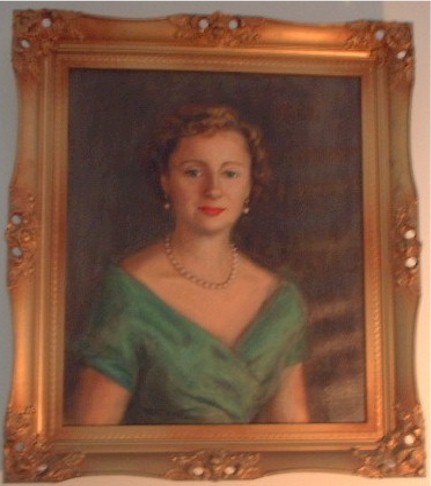
My mom is gone. She died peacefully 11 hours after she was taken off the morphine drip as a result of my brother’s insistence. She never woke up. I guess our collective magic worked. Or maybe it was just that her time had finally come.
I have gone back with my brother to his house to get her clothes ready and find her rosary. Tomorrow I will go and stay with friends in Albany until the funeral later this week in Yonkers, where our family is buried.
My brother will finalize the funeral arrangements. I am tired of getting into arguments with him.
I write this clumsily on my iPhone because my brother has disconnected his wifi that I use for my netbook because he doesn’t want me blogging. Well, isn’t that just too bad.
He is already harassing me about crumbs on the floor and too many lights on. I thought my mother’s death might diffuse his nastiness toward me. Wrong, again.
But I will get through this and then go home. And not come back.
Atheist though I am, I still marvel at the awesomeness of synchronicities.
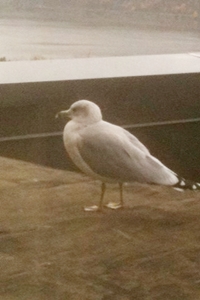
All afternoon today, as I cried and blogged and cursed, and my brother argued, and my mother lay still and panting in her hospital bed, the fat gull flew and strutted around the roof outside my mother’s window, screeching, The sound was like fingernails on a blackboard. There was no ignoring it.
So, I googled “seagull totem” and found this, which I share here:
Spiritual Messengers
Sea Gulls are messengers from the gods, especially ancient Celtic deities.
They bridge the gap between the living world and the spirit world.
Opening yourself to their energy enables you to communicate with the other side.
Sea Gull can also give you the ability to soar above your problems
and see things from above. Seeing all the different viewpoints.
Better than any fortune cookie.
And then, went I went outside to get another book from my car, I found the item in the photo below in my book bag, and I hung it on the rack on my mother’s bed that is supposed to hold IV bags.
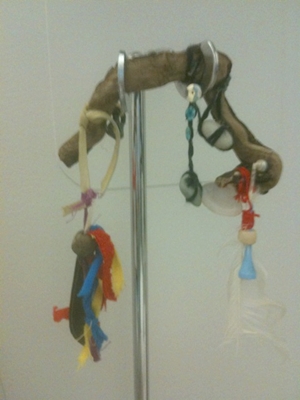
It’s the talking stick that I and my five women friends jointly and ritually made from a root, stones, feathers, ribbon, yarn, thread, spangles, and even a golf tee. Crone magic of a very special kind.
My daughter chants to set my mother’s spirit free. And I embrace roots and wings for my own spiritual sustenance.
Such everyday magic, these synchronicities.
Go here for Deathwatch Diary (One)
Go here for Deathwatch Diary (Two)
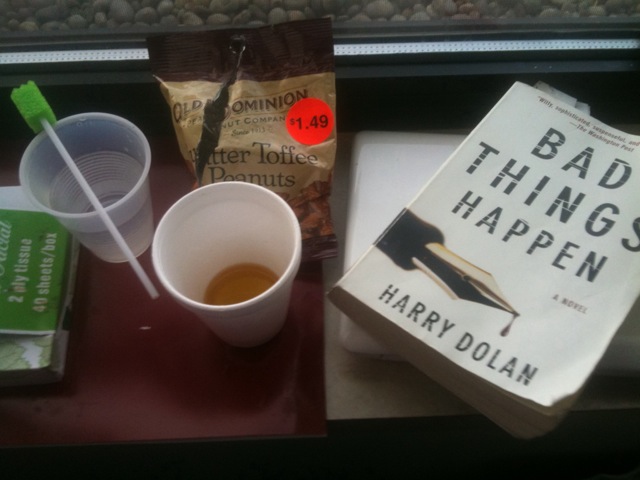
I should have known that it would be a bad omen to take the book, above, to read while sitting through the deathwatch.
Bad things did happen. My brother bullied his way into making me the obstructionist in reaching an agreement on the care my mother will get in her final hours. With pressure on me from more than a half-dozen hospital staff, he had her taken off the morphine drip. I finally gave in, provided that the nurses can put her back on if she demonstrates distress. The problem is that my brother interprets her distress as “feistiness.” I can only hope that she is so far gone that her brain is dead and will not relay pain messages to her nerves.
It remains to be seen whether the nurses will, indeed, put her back on if she looks like she needs it. Or will my brother bully them into folding to his interpretations.
Let this be a lesson to all who delegate health care proxies and power of attorneys. Choose carefully. Choose someone who doesn’t have his/her own agenda for how your long life ends — which should be neither bang nor whimper, but rather a peaceful slide into oblivion. Or wherever.
Yes, I’m pissed at the staff here, who let him do the wrong thing for the wrong reason. I’m pissed at myself that, with little sleep for 48 hours, I folded under pressure.
This is about me, and I’m not done yet.