The following from here:
Dear Members of the U.S. Senate,
Welcome back! The 109th session of Congress has just begun. I’m watching you on C-SPAN right now and you all look so snap-happy and clean-faced. It’s like the first day of school all over again, isn’t it?
I have a favor to ask of you. Something isn’t right with the vote from Ohio. Seems a lot of people didn’t get to vote. And those who did, thousands of theirs weren’t counted.
Does that seem right to you? I’m just asking. Forget about partisan politics for a moment and ask yourself if there is a more basic right, in a democracy, than the right of the people to vote AND have ALL their votes counted.
Now, I know a lot of you wish this little problem of Ohio would just go away. And many of you who wish this are Democrats. You just want to move on (no pun intended!). I can’t say I blame you. It’s rough to lose two elections in a row when the first one you actually won and the second one you should have won. And it seems this time around, about 3 million more Americans preferred to continue the war in Iraq and give the rich more tax breaks than those who didn’t. No sense living in denial about that.
But something isn’t right in Ohio and more than a dozen members of the House of Representatives believe it is worth investigating.
So on Thursday at 1:00pm, Rep. John Conyers of Detroit will rise and object to the vote count in Ohio. According to the laws of this land, he will not be allowed to speak unless at least one of you — one member of the United States Senate — agrees to let him have the floor.
A very embarrassing moment during the last session of Congress occurred in the first week when none of you would allow the members of Congress who were black to have the floor to object to the Florida vote count. Remember that? You thought no one would ever notice, didn’t you? You certainly lucked out that night when the networks decided not to show how you shut down every single member of the Congressional Black Caucus.
No such luck this year. Everyone now knows about that moment of shame. Thank you? You’re welcome.
But this Thursday, at 1:00pm, you will have a chance to redeem yourself.
Congressman Conyers and a dozen other members of Congress have some serious questions about how the Republican secretary of state in Ohio (who was also the state’s co-chair of Bush’s reelection campaign) conducted the election on November 2. The list of possible offenses of how voters were denied access to the polls and how over a hundred thousand of their votes have yet to be counted is more than worthy of your consideration. It may not change the outcome, but you have a supreme responsibility to make sure that EVERY vote is counted. Who amongst you would disagree with that?
If you would like to read more about the specific charges, I ask that you read these two links: “Senators Should Object to Ohio Vote” —by Jesse Jackson and “Ten Preliminary Reasons Why the Bush Vote Does Not Compute, and Why Congress Must Investigate Rather Than Certify the Electoral College”. I am asking everyone on my mailing list to send you a letter joining me in this call to you to do your job and investigate what happened before you certify the vote.
It only takes one member of the House and one member of the Senate to stop the acceptance of the Electoral College vote and force a legitimate debate and investigation. Do you know why this provision is set in stone in our nation’s laws? I mean, why would we allow just two officials in a body of 535 members to throw a wrench into the works? The law exists because nothing is more sacred than the integrity of the ballot box and if there is ANY possibility of fraud or incompetence, then it MUST be addressed. Because if we don’t have the vote, what are we left with?
C’mon Senators! Especially you Democrats. Here is your one shining moment of courage. Will you allow the gavel to come down on our black members of Congress once again? Or will you stand up for their right to object?
We will all be watching.
Yours,
Michael Moore
www.michaelmoore.com
mmflint@aol.com
I reprinted Moore’s open letter in its entirely in case my readers are not on his email list or don’t check his website or (horrors!) don’t like him and won’t read anything he writes. As usual, though, he comes through, loud and clear.
UPDATE: Via Keith Olbermann’s weblog at MSNBC:
…it appeared all but certain in early evening Wednesday that House Democrats had secured the support of up to half a dozen Senators to formally challenge the Electoral College slate from Ohio, when the votes are opened before a joint session of Congress…
and
The ad hoc group formed by Representative John Conyers of Michigan has also today published its staff report, concluding that before, during, and after the election in Ohio, many state laws may have been broken, in every area ranging from the allocation of voting machines, election day “anomalies,” and the recount. It recommended a formal Congressional inquiry, and additional legislation to reform voting laws.
our less-than-brilliant president.
Via Norm Jensen’s blog, a telling video clip.
Meanwhile, from ABC online:
The Bush administration is preparing plans for the possible lifetime detention of suspected terrorists, including hundreds whom the Government does not have enough evidence to charge in courts….
Don’t look at me. I didn’t vote for him.
Some Dissident Praise for Kalilily
The following is why blogging keeps me blogging.
I got an email today from a Dr. Lilian Friedberg which said:
Hello Elaine,
I recently discovered your website, and was so delighted (and sincerely impressed with very good content) that I mention it in my most recent column, “Voices of the Peoples” at the ClarkPost. Here is the URL, this month’s column is called and includes a paragraph or two about your site: The Death of Democracy in America: The Foundering Fathers and the White Roots of Peace
I do hope you’ll understand my discussion of your site in the appreciative and playful spirit it is intended. It is a wonderful place to visit.
Another dissenting Crone,
Lilian Friedberg, PhD
Cognitive Dissident
Dr. Friedberg’s piece is long but worth reading for the well-researched perspective she gives not only on the death of democracy in America, but also on its origins and the misconceptions most people have about its development.
Of course, to me, the best parts are what she says about Kalilily, which I post here with a big dissident smile on my face:
To my cognitively dissonant delight—one ray of inspiration did appear on an otherwise dim string of search results which led me to the weblog of Elaine of Kalilily, Self-Proclaimed Resident Crone of Blogdom, who also describes herself as a “True Blue American,” and whose blog entry for November 5, 2004, “My Blue America,” glimmers with subtly placed signs of hope. The real gems are buried in the links she supplies: truths debunking myths of Puritans fleeing religious persecution only to export it to the colonies in the form of domestic tyranny abroad, truths about witch-burnings, and about the foundational principle of genocide underlying the birth of this nation—on a link that’s worth singling out here, since it’s rather cleverly cached behind a hyperlinked reference to the military that benignly obscures the page’s content.
Genocide and The American Indian Peoples
Nor did I leave Kalilily’s site without finding the scoop I was looking for on the founding fathers, in particular as they relate to the third part of this essay, The White Roots of Peace—but we’ll return to that in a moment.
Emoticons cannot express my response to the quality and truth content of these treasures on a site that looked, at first blue blush, to be an exercise in kitsch- and cupcake-artistry. Just goes to show, never judge a blog by its clip art.
About the time I hit the genocide link, I went back and, with a quizzed “who-the-hell-is-this-person” look, and clicked on the “ABOUT ME” link. Voila!: My faith in the American people restored. At the risk of offending the self-proclaimed Crone of blogdom, I must admit what first came to mind: “Well, I’ll be damned,” I thought, “it’s just a little old retired grandma sitting there raising hell at the keyboard!” (That wouldn’t be an altogether fair assessment of a rather accomplished career woman and crafty writer who truly has earned her Crone-Coronation, so I invite the reader read site the rest of the story, which includes a great pic of the author.
Rest of the Story
And it was on Elaine of Kalilily’s site that I found one of the spokes in the wheel I was hoping to “uninvent.”
The people of the Six Nations, also known by the French term, Iroquois Confederacy, call themselves the Hau de no sau nee (ho dee noe sho nee) meaning People Building a Long House. Located in the northeastern region of North America, originally the Six Nations was five and included the Mohawks, Oneidas, Onondagas, Cayugas, and Senecas. The sixth nation, the Tuscaroras, migrated into Iroquois country in the early eighteenth century. Together these peoples comprise the oldest living participatory democracy on earth. Their story, and governance truly based on the consent of the governed, contains a great deal of life-promoting intelligence for those of us not familiar with this area of American history. The original United States representative democracy, fashioned by such central authors as Benjamin Franklin and Thomas Jefferson, drew much inspiration from this confederacy of nations. In our present day, we can benefit immensely, in our quest to establish anew a government truly dedicated to all life’s liberty and happiness much as has been practiced by the Six Nations for over 800 hundred years.
The Six Nations and the Oldest Living Participatory Democracy on Earth.
[UPDATE: After contemplating the Dr.’s reference to “cupcake artistry,” I decided to clean up my kitsch and make my site look more the way it did when I started — not so clip-arty. Less is more, right?]
———————
And so, on this second day of a new year, with a week facing me probably filled with rounds of doctor’s visits trying to figure out what’s going on with my mom’s swollen lips and with trying to get ready to go out and stay with my daughter later in the month while she recuperates from some surgery (now, that I don’t mind doing because I get to be with my toddler grandson) — as I sit here feeling sorry for myself for missing what’s supposed to be my Golden Years — I get the message. Thank you, Dr. Friedberg.
Blogging keeps me going. Keeps me golden. At least it keeps my brain from getting too tarnished.
Much of my original interest in the the legacies left to this country by the Six Nations was stirred up while I worked in the New York State Museum, where the histories of the Hau de no sau nee are preserved and revered. It was there I learned about the status and influence that women, especially older women, held in those Native American communities. Among all of the important democractic legacies of the Six Nations that our American system has discarded is the fundamental role of the Clan Mother, the Crone. Dr. Friedberg explores those legacies in her “Death of Democracy” article.
If you want to read more of what Dr. Friedberg, my newly discovered “sister-in-croney-dissidence.” writes, check out the following:
Election Results Challenge Our Faith in America and Its People
An Open Letter to the NYT (and by Implication) the Rest of the US Media Who Are Trying to Whitewash the Election Scandal
Worse than Watergate? Yep. Worse Yet. Worse than Hitler
I Love the Smell of Cold Turkey in the Morning: A Week in the Life of
America
God Bless America! Letters from the Heartland: Open Letters to George W. Bush October 14 – Nov 3, 2004
———————
And, speaking of “golden,” I thought these were supposed to be my Golden Years. Right.
Great op ed piece in my local paper today by Silvio Laccetti, a professor who wrote the piece for the Knight Ridder/Tribune News Service. I can’t seem to find it anywhere else on the web, at least not yet.
Here are just some excerpts from “A Sandwich Generation Reaches Its Golden Years:”
We are the smallest generation. Once called the silent generation, we are the pivotal generation of the last 60 years. We are the rock ‘n’ roll generation, born from 1940 through 1945. My generation. This New Year, 2005, the first of our number arrives at the golden age of 65.
Sandwiched between the greatest generation and the baby boomers, we occupy our own high place in America’s social history. We have served as foundation builders in key areas of American life, and we have cemented the social structure of the last 35 years. Our generation is recognized by many names.
Of course, as the rock ‘n’ roll generation, we discovered and popularized the music that radically changed popular culture. In the early ’50s, proto-rock ‘n’ rollers found the moondog music of black artists on obscure R&B stations. “Rock” became a cultural attitude, infusing the arts, theater and even politics. We were the first modern generation of rebels, albeit rebels without a cause. We said rock ‘n’ roll would never die and, for better or worse, it hasn’t.
Clearly, my generation is also the atomic generation, closely identified with the 1950s and their epochal changes. Domestic joy and tranquillity contrasted with apocalyptic visions of annihilation.
[snip]
Because we passed through so many mini-revolutions, we were also the cement that binds much of our society together. We went from the 78 rpm record to the DVD recorder disc, from the typewriter to the Palm Pilot.
[snip]
Forty years later, it’s 2005 and most of us are staying alive (oops). Thanks to new attitudes toward seniors and second careers, and with continued help from medical advances, we remain an undeniable part of America’s future. As veterans of four decades of change in which America became the sole world superpower we still have much to contribute. We will not fade away.
Yup. There’s a dance in the ol’ dame yet.
Is this what the rest of the year will be like?
So, I go to wake my mom up at 11 this morning, and I realize that her lips look like Goldie Hawn’s in “First Wives Club” — you know, too much collagen for the lips in question.
My mother has no other symptoms, just swollen lips. OK. An allergic reaction, I figure. But to what? We ate the same food yesterday. Unless she snacked on something. Or is it one of her medications? She’s on an antibiotic for an inflected and swollen gland on the side of her face. Or is it all part of the same syndrome? Or something else entirely, like a bug bite of some sort?
I give her two Benedryl, put her back in bed. Take her off all meds except for her heart. I’ll call her doctor tomorrow if she’s not better.
Is this the way it’s going to be from now on? Some kind of crisis at least once a week? Is this what the rest of the year will be like? Is this what the rest of her life will be like?
Happy New Year.
Science Knows
Not only does science know why the tsunami happened, it can give precious hours of warning. If a small fraction of the tax breaks handed out to churches, mosques and synagogues had been diverted into an early warning system, tens of thousands of people, now dead, would have been moved to safety.
Let’s get up off our knees, stop cringing before bogeymen and virtual fathers, face reality, and help science to do something constructive about human suffering.
The above from The Guardian via Norm Jensen’s One Good Move.
Also, via Jensen: William Pitt has started his own weblog at Truthout.
AND
an interesting discussion on “God is an Asshole.”
Poets Don’t Know
According to a piece by columnist Matt Miller, not knowing, and not denying that they don’t know, is what drives poets. Not knowing and denying that they don’t know is what drives politicians and ideologues.
Miller quotes poet and Nobel Prize winner Wislawa Szymborska:
Szymborska’s response to the ideologues is that “knowledge that doesn’t lead to new questions quickly dies out.” In her wonderful phrase, “it fails to maintain the temperature required for sustaining life.” And, as history has shown, from the Crusades to the Holocaust, such dogmatism can pose a lethal threat to society.
“This is why,” Szymborska says, “I value that little phrase ‘I don’t know’ so highly. It’s small, but it flies on mighty wings. It expands our lives to include spaces within us as well as the outer expanses in which our tiny Earth hangs suspended.”
If Isaac Newton, Marie Curie or countless others had not constantly said to themselves, “I don’t know,” Szymborska argues, most of what we consider progress would have eluded us. For example, what if, instead of being inspired to think about gravity, an unquestioning Isaac Newton simply gobbled up his fallen apples?
Thus Szymborska insists, in words that have wider application, that “poets, if they’re genuine, must … keep repeating ‘I don’t know.’ Each poem marks an answer to this statement, but as soon as the final period hits the page, the poet begins to hesitate, starts to realize that this particular answer was pure makeshift, absolutely inadequate. So poets keep on trying, and sooner or later the consecutive results of their self-dissatisfaction are clipped together” as their legacy.
Substitute the words “policymaker” for “poet” and “policy” for “poem” and the political lesson is clear. In solving human problems – the purpose, after all, of politics – unmerited certainty is the road to ruin. It doesn’t take a genius to see that our problems are complex. Yet when it comes to stimulating the economy or planning for the day after in Iraq, how often have you heard a politician admit, “I just don’t know”? Our leaders pretend they have “answers” because they think we expect them to act that way. Often we do…… Maybe if our leaders became a little more like poets we’d all muddle forward better together.
I liked my life better when I had the space and time to do, according to Szymborska (as reported by Miller), what poets do:
“Someone sits at a table or lies on a sofa while staring motionless at a wall or ceiling. Once in a while this person writes down several lines, only to cross out one of them 15 minutes later, and then another hour passes, during which nothing happens”.
“Their work,” she writes, “becomes one continuous adventure … A swarm of new questions emerge from every problem they solve. Whatever inspiration is, it’s born from a continuous ‘I don’t know.'”
As a caregiver, there are so many, many things I have to know, have to make decisions about, keep track of. I don’t have the “disposable” time to not know, to embark on the poet’s great adventure.
Today begins a new year, but today is like yesterday, for me, confined by tediuim and details and interruptions. I have made some resolutions, though.
I’m going to spend one day a week throwing things away, cleaning out those parts of my life that I can clean out. The clutter of things that I really don’t know if I’ll ever need again. If I don’t know, I’ll let it go.
I’m going to stop snacking at night. Oprah said that’s the key to losing weight. But that’s not the reason. Getting the nightime acid reflux under control, that’s the reason. Losing weight will be a bonus.
I will continue to stand against dogmatism, which is easy in the “big picture” but a lot harder in the “little picture” because my mother, who some friends of mine once titled “The Pope of Yonkers,” is dogmatic about just about everthing.
Even if I’m not writing poetry, I will read more of it. I will make Szymborska’s words my mantra:
I don’t know. I don’t know why. I don’t know if. I don’t know who. I don’t know.
I don’t know.
I don’t know.
I don’t know.
“2004: The Year of Living Dangerously”
According to a piece in the Belfast Telegraph
— …This year has seen a succession of ferocious natural disasters, destroying cities and killing tens of thousands of people
–…Across the planet, the violence of the world’s wind and rain caused unprecedented economic damage, new figures reveal – adding to fears that the disastrous consequences of climate change are beginning to take effect
–….. the rate of natural catastrophes has taken a step change upwards in the 1990s, which is also the decade when rising global temperatures have become clearly apparent. The 10 hottest years in the global temperature record have all now occurred since 1990.
and
Stephen Tindale, the executive director of Greenpeace UK, said: “No one can ignore the relentless increase in extreme weather events and so-called natural disasters, which in reality are no more natural than a plastic Christmas tree.
“The World Health Organisation tells us that already 150,000 people die each year as a result of climate change. Sadly that hasn’t been enough to make world leaders sit up and take notice, but maybe this $100bn bill will. And since it comes with a dollar sign attached, it’s the type of language even George Bush might understand.”
Yet, there are still conservatives-in-denial, who keep insisting that global warming is no big deal and we need to keep capitalist economic issues at the forefront.
And still Bush and his ilk do their patterned praying to keep god on their side, and people like the one during the last horrific tsunami say things like “I’m grateful that God was watching over her and she got to a hospital.” (You mean that the other 59,999 people were not worthy of God watching over them???)
I’ve become more convinced that, if there is any kind of “god” out there, it is irrelevant to us here on Earth. We make our own destiny, our own fate individually; and we affect the destiny and fate of our fellow humans by what we collectively do and don’t do.
Will our Mother Earth smack us even harder in 2005? It’s not nice to screw with Mother Nature.
Not One Red Cent; Not One Damn Dime.
I often leave a comment on a post that’s worth making into a post of it’s own. As a matter of fact, this post of mine has a bunch of pretty interesting comments accumulating, as we explore the value of the Net effort to get people to stay away from spending any money in retail stores on Inauguration Day as a way to send a message to the Bush administration that we have not changed our minds about how we feel about his policies and procedures.
It turns out there is are two special websites devoted to this effort, where you can sign a petition and leave a comment. WWW.NOTONEDAMNDIME.COM and WWW.NOTONEREDCENT.COM Please spread the word.
Over on my other post (linked to above), I received a comment from someone named H Boroni, who tried to list the reasons why the Not One DamnDime boycott effort won’t work. This is what I replied:
Well, H Boroni, I guess it all depends on where you’re coming from and what you’ve learned along the way.
1. The NODD Day is a protest statement, meant to call attention to the fact that there are still many, many of us who are enraged by all that the Bush adminstration stands for and has failed to accomplish. Of course not all Americans will join the effort. Not all Americans marched in Washington at various times regarding the Gulf War or the Vietnam war of a woman’s right to choose. But the point was made by those of us who did. You’re missing the point.
2. The protest is as much to remind people like you as it is to remind the Bushies that half of America does not agree with you all. It is as much to remind the press and the rest of the world. We know that Bush knows. You’re missing the point.
3. It’s not meant to hurt or help the economy. It’s meant to be a visible and newsworthy protest. You’re missing the point.
4. Notice that I edited out the statement found in other versions of this call to dissent about “supporting the troops.” My support of the troops begins and ends with “bring them home so they don’t get killed.” That’s a whole other issue and doesn’t belong, I don’t think, in the rationale for this dissenting act. That’s my personal point of view.
5. The troops in Iraq are not fighting to protect America. The Iraqis were not the ones who orchestrated and carried out 9/11. The people there hate us and our troops about as much as they hated Saddam. America is more in danger from the actions of Bush than from any actions of the Iraqis.
From my point of view, supporting the current neocon administration is being part of the problem. Urging major governmental overhaul, through protest, dissent, sending emails, writing letters, being intelligently and vocally opposed to the current administration, is being part of the solution, part of the impetus for change. You’re missing the point.
To summarize, living in a state of denial, remaining uninformed about the reasons why America is in the mess it’s in, is what is stupid. You’re missing all the points.
One of my commenters suggested doing an organized spending boycott once a month, on some kind of irregular basis so that the stores can’t prepare for the slowdown by telling their hourly workers not to come in.
However it all falls out, on the day the Bush gets inaugurated –Thursday, January 20, stay out of the stores.
OPEN YOUR MOUTH BY CLOSING YOUR WALLET.
I Remember.
My mother didn’t remember. Neither did my brother. But I’ve been thinking about it all day.
Twenty years ago today, my father died of pancreatic cancer. He died at home, with my mother and I sleeping in a bed next to him. I was the one who awoke, in the early hours of the day after Christmas, to the silence in the room, the absence of that rasping, labored breathing. Before I woke up my mother and brother, I went over and sat by the edge of my father’s death bed and watched his face, finally relaxed into what looked like a smile.
My father never asked me to take care of my mother after he was gone. I don’t think he wanted to put that burden on me. But as he lay dying, fighting the inevitable despite the pain, I told him not to worry. I would take care of her. And by the next morning, he had finally let go.
I’ve told this story before, on my old weblog. I’m remembering it today, again.
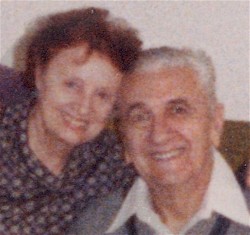
And so now I take care of my mother. And I’m thinking that I do it more for him than for any other reason. This is a photo of him and my mother less than 6 months before he died.

Graveside Testament
On the day that they folded him
barefoot and grim
into that final silence,
there was no space left to tuck a cry.
We fed him to winter,
to the honest needs of roots.
“There were signs,” she says
words muffled by the upturned collar
of the coat I have outgrown
and she has shrunken to fit.
Above her breath, four crows
defy the lacework
of a snowy sycamore.
“One day I saw three small doves
flying above his car.
And then there were the crows.”
A nervous rustle. A shift of feathers.
“They gathered in the trees behind our house
on the day he came home the first time.
Thousands, like charred leaves.
like black snow.
He had gone alone to the back porch
to face the sun.
Suddenly, he was in the doorway,
his face dark with anger.
He said the noise was killing him.”
From below the snow, a frozen sigh.
And so I bury a sprouting tuber
near the stone of my father’s grave
so that hairs of the tuber
will twine with his hair,
beckon the rain
and dance with the worm;
so that the tuber eyes
will watch in his place
for the message of the great crows
who keep vigil in all seasons
from the crotch of a crooked bough.
And I will lie on my father’s grave
and listen.
© Elaine Frankonis 1990
Slow Learning
Over on Blog Sisters (where I can feel comfortable posting and commenting now because I resigned from the job of Registrar that I was doing badly and feeling guilty about), Betsy Devine calls attention to a post on Seth Godin’s blog asking what are the thousand things that every third grader should start learning and know before she graduates high school. The discussion is carried on over at Joi Ito’s blog as well.
Before I retired from the NY State Education Department, I worked as part of groups that developed a variety of the state’s “Learning Standards” (pdf document) — what kids should learn, know, and be able to do in various subject areas by the time they graduate high school. [Seth, these kinds of standards exist in just about every state education department. You should find out what your state has as theirs.]
In all of that jargon, no where does it say that the funamental thing that kids should learn is to love to learn, to find it interesting and fun and exciting to discover and track down facts they didn’t know before. Kids who learn the pleasures of investigating, discussing, analyzing, theorizing, creating, and sharing can’t be stopped from learning. (b!X is a fine example of this; he had little use for the regimentation of the public school system, but learning to him was and is the same as breathing.) Kids who have never had the mentoring and encouragement and example necessary to develop a love of learning often refuse to learn despite the best efforts of teachers who keep their noses to the learning standards grindstone. Kids who are excited by learning naturally want to communcate what they learned and so they also are more interested in developing communication skills.
One of the things that always bothered me (as a teacher of junior high kids and later as a not-always-successful “change-agent” on the state level in education) is that kids never really are given the “big picture.” What they get in school are the bits and pieces of history, literature, technologies etc. — the specific skills they need to function — without enough of an understanding of how humanity got to the point we’re at today where those skills are important.
For example, with all of the computer technology we have today, why doesn’t some educational-tools company come up with animated maps of the world that show each of the various theories of where the early homo sapiens began to establish communities some 2.5 million years ago and how they migrated to other parts of the world. Something like this or this or this gives some of the facts, but to today’s visually sophisticated kids, it’s boring and doesn’t easily give a sense of the scope and interrelated movement of the planet and its people.
I can imagine animated maps of the land and water masses of the planet evolving through time and the theories about the location and migration of homo sapiens groups superimposed on those maps. You’d need an animated map for for each designated time period as it relates to each theory. And even — not that I subscribe to the benefit of doing this — there can even be an animated map reflecting the “Adam and Eve” biblical theory.
Being able to visualize the migration across the planet of the human species over all of those millennia would be a giant step in giving young children a true understanding of how we all have common roots.
It would help them understand how slowly but clearly nations and cultures began to branch away from the early human communities, to understand that we have more in common with each other as humans than we have differences.
These kinds of animated and layered maps could be created to show how climate influenced culture, economics, and national identity; how the borders of countries changed over time as a result of wars and oppression.
Kids today understand just what a small world it is. The Internet makes it all small and immediate. Kids need a place to get the big picture, a sense of their place in the geological, geographical, and historical saga of our planetary evolution.
The little picture provides immediate, close satisfaction. The big picture offers wonder and expanded horizons.
Now, does anyone know how I can go about copyrighting my idea for this kind of educational software CD so that I can sell it to an educational software developer??? Since I blogged the concept here on December 25, 2004, does it become my intellectual property??