my life as sweater metaphor

I’m not the first knitter to come up with the idea that “knitting is like life.” (Google it and you’ll see.)

Even if you’re not a knitter, you probably get the point. And if you are a knitter, you might find my experiment in intuitive, no-pattern knitting something you might like to try. (“Intuitive Knitting” will also come up in a Google search, but what you’ll find is not what this post is about.)

One of the reasons I knit is that I prefer to have a useful product as the result of my creative efforts. And I prefer to play with processes that don’t come with patterns of exact directions. I like to wing it and see what happens. Thus, the title of this post.

For this particular intuitive endeavor, I experimented with techniques I had learned from two books: “Modular Knits” and “No-Pattern Knits.” Mitered squares, triangles, and the simple garter stitch became the basis of my improvisational project.

I started out with a few skeins of Vanna’s Choice yarn that I bought on sale a while ago, although I had no specific plan for their use. I just liked the variegated color scheme.

As I expected, I ran out of the yarn and went back to Joann to get more — but the store didn’t have enough of the dye lot, so I wound up buying a few skeins of a different dye lot as well. And a complementary solid color in case I decided on a contrasting trim (which, obviously, I did).
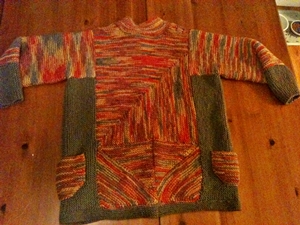
As I continued to improvise, I discovered that not only were the two dye lots of what was supposed to be the same yarn a little different in color; they also were a little different in thickness. Connecting one with the other was a mathematical challenge (the number of stitches per inch changes with the thickness of the yarn), but I persevered.

I began by using one of the dye lots to create a mitered 12 inch by 12 inch garter stitch square that became the center of the back of the sweater. The dimensions were arbitrary; it was just a place to start. And this is what the back of the finished sweater looks like. You can see the differences in the shades of color in the variegated yarn. And because I never did figure out the stitch gauge exactly, the bottom ballooned out a little and I had to take in the extra “fabric” with my sewing machine. (Sometimes I REALLY have to improvise!)
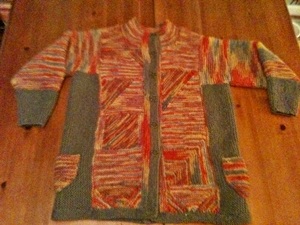
Coordinating the two thickness of the same dye lot of yarn worked better on the long panels that I knitted as the basis for each front side of the sweater. And I made the two sides different from one another. (I find asymmetry aesthetically pleasing.)

By using the solid color yarn to pick up stitches along the sides of the variegated panels, I added to the width of the sweater so that it would fit around me. Then I picked up the stitches around the top of he square armhole and used the Norwegian technique to knit the sleeve from the top down. I added the solid color cuffs and the variegated color pockets later. The neck band was definitely an intuitive romp — garter stitches with arbitrary decreases made on the right side.
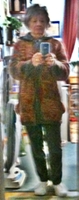
This is a photo I took of me in the sweater (with my i-phone, in a mirror; but you get the general idea). It’s oversize, so I’m wearing a hooded sweatshirt under it. It was in the lower 40s today, and I was toasty warm when I went for a walk this afternoon.

I’ve already gotten unsolicited complements on the sweater. After all, it’s the only one of its kind in the world.

I suck at canvas and paint. My efforts at quilting have yielded marginal results. But give me a few hanks of mismatched yarn and I’ll amuse myself for months, playing at coming up with something that’s uniquely mine.

Some people make lemonade out of lemons. Me? I’d try for a lemon tart.
bix’s birthday

He goes by b!X, to be exact, but he didn’t always. We named him Christopher and called him Kit (after Kit Marlowe). We were both English majors, of course. No one calls him “Kit” any more (except for family when he’s not around).

He’s not around family much these days, since he lives about as far away across the country from us as is possible. I don’t think the previous sentence indicates the reason, but there he is.

He was born on my father’s birthday — about the best gift you can give a grandfather: his first (and only) grandson. I remember hearing my brand new son give a yell even before he was all he way out of my body.

Yet he grew up quiet and thoughtful and self-contained. He still is. Unless he’s on the interwebs, and that’s where he exercises his powerful, passionate, and persuasive voice.

It’s his birthday today. He is the age of the answer to life, the universe, and everything.

I wish him a the happiest of birthdays. Or, in the words he uses, “a pleasant day of origin.”

I’m glad he is my son, wish his dad were still here to share this auspicious day with him, and send him my love across life, the universe, and everything.

on reading a friend’s short stories

While I eat lunch, I am reading an anthology of short stories written by a friend. I usually read while I eat and while I’m waiting for sleep to come. I go through several books a month. I guess that means I eat frequently or suffer from insomnia. Actually, each is true to some extent.

Even back in college, I was intimidated by this writer-friend’s erudition. “Erudition.” That really is the perfect word for just how broad and deep his learning is. And it’s reflected in the narration of many of his stories, which assumes that the reader has at least heard of the great philosophers and writers whose works populate a good liberal education. The characters in these tales, however, run the gamut — from auto mechanics and health care workers to college students and professors. They are stories that are inclusive of age, race, marital status, and economic realities. They are stories about life as experienced by a narrator (and it is not always the same one) who is attuned to the nuances of the moment.

For me, in every story, it is the voice of the narrator that catches and guides my attention.

And that is the very reason why I feel compelled to muse about reading short stories written by a friend whose path periodically keeps crossing mine. He uses names and characters that are familiar to us both, events that coincide with what I know of his life. He is the writer; but is he always the narrator?

While, as his friend, I am enticed to wonder about the origins of these details, the truth is that it doesn’t matter to me, the reader. He is writing from his own experiences, recreating and rearranging them to suit his fiction. It’s what good writers do.

Despite knowing that, I can’t help wondering which details really happened. Did his young family really get evicted out of their apartment the day before one Christmas (as happens in one of my favorite stories in his last anthology)? I guess I can always ask him, and I probably will. (I tend to think that, while the characters in the story are drawn from his life, the situation probably isn’t.) His answer will not change my enjoyment of the story, but it will satisfy my “friendly” curiosity.

Finally, his stories bring to my mind lyrics from “Circles,” one of my favorite songs from one of my favorite albums by now-gone Mary Travers:

There’s no straight lines make up my life,
and all my roads have bends.
There’s no clear-cut beginning,
and, so far, no dead ends.

(Just like this blog — which, I assure you — is totally non-fiction.)

dealing with that disturbing “D” word
— being a midwife to the dying

Death is the final taboo in our culture. We can talk about illness and religion, politics and sex, gender and race issues, but the D word is still difficult for people to utter in polite company….

From Last Acts of Kindness: Lessons for the Living from the Bedsides of the Dying, by Edith Redwing Keyssar.

I have a unique relationship with death. My father was an undertaker, and we lived in an apartment above his business. Contemplating death and dying — my own and others’ — has been a part of my life since childhood. I have sat vigil during the hours and days of the deaths of both of my parents. At the age of 71, I am closing in on my final years. I have no control over when or why I will die; but I am learning about the choices I have about “how”.

After leaving a comment on a post on Time Goes By about Judith Redwing Keyssar’s book (quoted above), I have had a chance to read that book myself. And, doing so comes at a particularly relevant time in my life as I await my first assignment as a hospice volunteer.

During the intense training that I had to undergo, I learned about my role and responsibilities as part of a hospice team and examined my reasons for choosing this kind of volunteer service. I found that the experiences that Keyssar shares in her book take whatever personal motivations I have for becoming — in her words –“a midwife to the dying” and draws them into an even greater context of compassionate and cosmic significance. As part of her stories, Keyssar reiterates the point that it doesn’t matter what one believe about an “after-life;” the focus of her message is to live fully while embracing the fact that we, after all, are all “terminal.”

At the end of her book, she provides a list definitions, internet links, and bibliographical references if the reader chooses to further explore the range of information available about compassionate care during the final stages of life.

The final chapter in Keyssar’s book is a poetic Epilogue (see below) that captures the intent and the spirit of the mission of those who choose to honor and celebrate the final, fleeting days (and sometimes months and years) of a human life by becoming part of a palliative care and/or hospice team.

Epilogue
Job description For Any Member of a Palliative Care Team

I am here to witness
the sacred hearts
broken open.
Friends,lovers, families
whose loved ones die in their arms,
in the homes, in their beds, in hospitals or other places.
Peacefully, nor not.

I am her to witness
the sanctity of human life
as the spirit is released from the temple
to join once again, with the invisible cellular infinity
of the Universe,
the mitochondria of the Milky Way,
becoming energy to light the stars,
since we know —
the energy we manifest as a particular human being,
like any other,
can neither be created
nor destroyed.
God, by any other name by any name, by many names,
by no name,
Is
One.

I am here to witness
the breath
as it enters the body
and exits for the last time.
The miracle of birth.
The miracle of death.
The miracle of each moment in between:
Life
the infusing of consciousness
into each and every cell
enduring every moment
we are here
on earth.

I am here to witness
to feel
to experience
to honor
to know that Love is eternal.
to share this blessing
in gratitude.

and to perform any other duties
required.

Last Acts of Kindness is a book that should be read by everyone who expects some day to die.

____________________________________________________________

As I was writing this post, today Ronni Bennett at Times Goes By posted another piece that includes additional thoughts on death and dying. The conversation continues.

that long-gone gold

Those really were my golden years — those four college years between 1957 and 1961. And so I was willing to help plan our 50th class reunion. I even sewed a big 50th reunion banner and put up a class reunion blog. That was the fun part.

But it turned out that my closest “girl” friends couldn’t be there for the part that was supposed to be the most fun. When I checked in with one of them a month before the event, I found out that she had moved into an “assisted living” facility (in the same nursing home building where her husband, also a good friend of mine, was confined to a wheel chair with a deadly combination of Parkinson’s and Alzheimer’s diseases). She told me that her daughter had taken away her car and license, and so there was no way she could attend the reunion.

(If she is there, will I not be far behind, I wonder. We are the same age, same height, same coloring; we shared wardrobes for four years and together descended on Fort Lauderdale, Florida for one glorious Spring Break. Life is not fair.)

A week before the event, my other close friend called to tell me that she had just had a mammogram and was told to go in for a biopsy. The biopsy turned out to be early Stage 1 breast cancer. She had a lumpectomy yesterday and will proceed with the recommended treatment. Life is not fair.

So, did I have fun at my 50th college reunion?

Well, I have to admit that there was a certain amount of pleasant nostalgia that propelled me through my planning committee tasks. Some things went right. Some things went wrong. What went wrong had to do with logistics; what went right had to do with having a chance to connect with some of the 50-years-older people whom I knew and liked back in those golden years.

As a female college freshman back in 1957, sharing a room in a small “group house,” I lived under rules that today’s female college freshmen would never tolerate: we had curfew hours, dress codes, no males allowed beyond the front room and not even there after 10 pm. Two of the girls who shared that group house with me came to the reunion. Seeing them again was part of the fun.

At the reunion dinner, a table covered with memorabilia from those golden years included a copy of the annual literary magazine from 1959. No, it didn’t include any writing by me. In 1959 I was too busy dancing in college musicals and writing a gossipy column for the college newspaper. And drinking beer. And dating. And joining a sorority. And cutting classes to TGIF. Many of my reunited classmates tell me that they remember me as always smiling and happy. Heh. Why not. Daddy was paying the bills and I was off absorbing the joys of life, the universe, and everything.

That’s right. I was no scholar. I managed to balance out my Cs and Ds with a greater number of As and somehow graduated as the B+ person I continue to be. But I digress.

From your absinthe tinted green dreams and
soulless wanderings across deserts of the mind, came truth–
ice-essence truth……

On page 32 of the literary magazine, I find a poem that begins with the above lines — lines inscribed on the flyleaf of a paperback book of Rimbaud’s poems by the talented young man who wrote the poem and gave me the book. I learned that he passed away a year and a half ago. I wonder if he had still had that tousled red hair, that red beard, that passionate, dark, beat-poet intensity. He almost seduced me. But I wasn’t ready yet, back in 1959.

The literary journal also had some pieces by his best friend, who also was my friend, and whose family became friends with my family after we both married and had kids. He is still writing. We lost touch more than a decade ago, although I had learned about his wife’s tragic illness and death sometime along the way.

Bob decided to come to the reunion at the last minute, and we sat together at dinner, recalling those mellow days and nights when we hung out together in front of his future wife’s sorority house — he and his dark-haired Irish lovely, and me with my brooding red-headed boy. And he asks me if I am happy. And what I can answer is that “I am not unhappy.” We plan to keep in touch. I went and ordered his recent book of short stories.

I supposed the ego-stroking highlight of my class reunion (which was part of the university’s Homecoming Weekend) was having a good-looking gray-haired guy (who was a college year behind me) come up to me to tell me that he still remembers the first time he saw me. I was sitting at the long table at the bar we all went to on Friday afternoons. He said that he remembered what I was wearing — a brown skirt and sweater. And I was smiling. And he thought I was gorgeous.

I guess it was a good reunion after all.

where the time went

Let’s see, now. Over the past several months:
— went through intense training to be a hospice volunteer
— help to plan, implement, and enjoy my 50th college class reunion weekend
— set up and kept up a blog for my college graduating class

That’s where my time went. Now it’s time to start posting again — thinking and writing and posting. But first I need to get some sleep. Like Scarlett, I’ll think about that tomorrow.

too soon old, too late smart
OR NOT

I am about to go to war.

I didn’t take the advice of friends and family and went ahead and bought a brand of computer that turned out to be the mother of all lemons. It had problems from day one, but, a persistent bitch that I am, I kept calling the customer service techs and kept getting each problem (I thought) taken care of. Until it finally totally crashed.

So, they sent an on-site repair person, who put in a new motherboard and hard drive.

Uh uh. Still no boot up.

I’m trying to get a refund but cannot seem to be put in touch with someone who can take care of that. (It’s a couple of weeks past the 30 days during which one can do a return.)

Today, I did what I should have done before I ordered the infernal machine and googled for complaints about that company. I found hundreds. Maybe even thousands.

So, I sent a letter to the company, enclosed copies of some of the complaints that I copied from just one website, and gave them a choice: give me a refund of the price of the computer and the service contract that I bought with it, or I’m going to war. Online. Virally. Maybe even with a youtube plea to that company to take pity on a poor old lady living on a retirement income. Certainly with a website that documents all of the thousand complaints about that company. And then I’ll tweet and fb the url. And I’ll file my own complaints on every consumer complaint site I can find.

I will become a thorn in their side, an enemy to the death — a hellcat of an old lady whom they wish they had never met.

I might be old, but I’m internet smart and know how to use it as a weapon in my defense.

Unless they refund all of my money and email me the UPS postage to send the damned thing back; then I’ll back off. As the Tao de Ching says — “no fight, no blame.”

But if they don’t — well, did I ever tell you that Xena is my idol?

ADDENDUM: Actually, the retailer from whom I bought it has just about as many complaints. Maybe I’ll make this fight a two-fer.

treadmill meditation

I don’t run. I walk with my eyes closed, holding onto the bar that measures my heart rate. I up the incline a little. Up the speed. Little by little.

I like walking with my eyes closed, but I can’t do that out in the street, where I would probably fall and break a hip. But it works here, in the exercise room at the Jewish Community Center, where it’s never crowded and the mirrors never reflect any hot young and toned females reminding me that’s it’s been a half-century since I was one of those.

I am meditating on my new gravatar, and I know that if I were a half-century younger, I would have my own mythic Avatar. She would probably look at lot like Xena.

I would be a player. Or, more accurately, a gamer. I actually don’t know much at all about gaming, but I “know” some interesting gamers because I follow them on Twitter — because my son follows them on Twitter.

There’s a whole subculture out there of gamers — of bright, creative younger people who Tweet and FB and blog and tumblr and instagram and flickr and all of those oddly spelled connective mechanisms that people my age usually have to look up on Wikipedia.

I’ve become a real fan of Felicia Day, a young woman of so many talents and creative projects that she takes my breath away. There’s no point in trying to describe her here, since her website has all the relevant information. You really should check out her funky youtube video of her song “Don’t You Want to Date My Avatar.” I’ve even gotten sucked into watching her , The Guild. It’s like I live on another planet from these creatives.

So, I’m on the treadmill, meditating, sort of, on being who I am. Not a gamer. Not even a player. Just a little old lady whose heart rate is up to 135 and I do, indeed, need to take a breath.

I open my eyes and look straight into the mirror into the mirrored eyes of a really good looking gray haired guy, who is working out at one of the machines in front of my treadmill. He smiles. He can’t be smiling at me, I think, but I smile back anyway.

Later, as I get up from the ab-crunching machine, he’s standing nearby, cooling off. He obviously takes this exercise thing a lot more seriously than I do. At least I get that impression from his trim physique and the gym shorts and fingerless gloves he is wearing. “This is a good time to come here,” he says to me. (It’s just a little after noon on a Sunday, and the place is almost empty.)

“Yes,” I say, smiling back. “Except it’s such a nice day out there. It’s a good day to be outside.” (Duh! What kind of a response is that??) For a minute we talk about the weather. I move on to the recumbent bike. He moves onto the the free weights.

Now I’m pedaling and thinking about the fact that I have no makeup on and barely ran a comb through my hair before I left home. I don’t come to the gym to meet men; I come to try and get my cholesterol under control and increase my stamina.

I might have to rethink all of that.

I’ll meditate on it.

why I’m addicted to pesto

I’ve been making fresh basil (from my garden) pesto and now I put it in just about everything except desserts.

You can find lots of recipes for basil pesto on the web (and all of them work fine), but I like my own the best — I use Basil, walnuts, honey, some fresh parsley, a lot less parmesan cheese than usually called for, and a little more garlic.

I put in on fish instead of tartar sauce. I even add it to V8 juice and my homemade gazpacho. I mix it with a little mayonaise and lemon juice and use it as salad dressing or a dip. The Food Network as a great list of 50 things to make with pesto.

And a basil pesto addiction is a really healthy one to have.

Accoring to here:
Basil has more phytochemicals than vegetables, has anti-inflammatory and anti-oxidants effects, protects the chromosomes and cells from damage, is good for digestion and stomach problems, and contains these minerals:
magnesium that helps relax heart and blood vessels.
calcium
potassium
iron
vitamin C
vitamin A to protect cell damage
vitamin K for coagulant factors in the blood and strengthening of the bones

As far as I’m concerned, the more garlic you add to the pesto the better. Garlic can lower your blood pressure decrease triglycerides and the bad cholesterol (LDL) and increasing the good cholesterol (HDL) The sulphur compounds in garlic can help with inflammations that may be causing arthritis or asthma. The sulphur compounds also act as antibacterial and antiviral agent. That is why they recommend eating garlic to keep colds away.

According to here:
The phytonutrient in garlic, called allicin, may help you maintain or even lose weight. Garlic gives great taste to all meals and can be added in all meals, sauces, stews, dips like hummus, guacamole, and mashed potato. You can even add it to a raw fresh delicious juice or smoothie. (Um, I think I draw the line at the smoothie thing.)

I add parsley for lots of reasons. According to this, parsley contains:
— myristicin, an organic compound found in the essential oil of parsley, not only inhibits tumor formation (especially in the lungs), but also activates the enzyme glutathione-S-transferase, which helps the molecule glutathione attach to, and fight against, oxidized molecules. Myristicin can also neutralize carcinogens like benzopyrene in cigarette smoke that can pass through the body, consequently fighting against colon and prostate cancer.

— an antioxidant arsenal that includes luteolin, a flavonoid that searches out and eradicates free radicals in the body that cause oxidative stress in cells. Luteolin also promotes carbohydrate metabolism and serves the body as an anti-inflammatory agent. Furthermore, two tablespoons of parsley contain 16% of the RDA of vitamin C and over 12% of the RDA of vitamin A – two powerful antioxidants.

— luteolin and vitamin C, which serves as an effective anti-inflammatory agent within the body. When consumed regularly, they combat the onset of inflammatory disorders, such as osteoarthritis (the degeneration of joint cartilage and the underlying bone) and rheumatoid arthritis (a disease causing inflammation in the joints).

— folate (or vitamin B90, which helps convert homocysteine into harmless molecules. A regular garnish of parsley can help ward off cardiovascular diseases, such as heart attack, stroke, and atherosclerosis.

— vitamin K, which is necessary for the synthesis of osteocalcin, a protein that strengthens the composition of our bones. Vitamin K also prevents calcium build-up in our tissue that can lead to atherosclerosis, cardiovascular disease and stroke. The vitamin K found in parsley (wo tablespoons of parsley have a whopping 153% of the RDA of vitamin K) is essential for synthesizing sphingolipid, the fat needed to maintain the myelin sheath around our nerves, and therefore our nervous system as a whole.

And, on top of that,

Parsley is the best weapon against garlic breath. That’s why many recipes that include garlic also include parsley. Chewing parsley with your garlicky meal seems to contain the problem to some extent.

But it’s not enough to just sprinkle a little parsley on top of what you’re eating. You need to chew at least one sprig of fresh parsley, ideally more, with your meal. Chop up a sprig of fresh parsley or two and add it to the meal somewhere, or put it on the plate as a garnish.

In case you’e wondering, here’s why I make my basil/parsley/garlic/honey pesto with walnuts:

Walnuts, a rich source of the omega-3 fat, alpha-linolenic acid (ALA), improve artery function after a high fat meal and may be even more important in a Mediterranean-type diet than olive oil in promoting heart health, suggests a small study from Spain (Cortes B, Nunez I, J Am Coll Cardiol).

Finally, I always cook with honey.

From here:

HONEY, a most assimilable carbohydrate compound, is a singularly acceptable, practical and most effective aliment to generate heat, create and replace energy, and furthermore, to form certain tissues. Honey, besides, supplies the organism with substances for the formation of enzymes and other biological ferments to promote oxidation. It has distinct germicidal properties and in this respect greatly differs from milk which is an exceptionally good breeding-ground for bacteria. Honey is a most valuable food, which today is not sufficiently appreciated. Its frequent if not daily use is vitally important.

OK. Now I’m hungry.