the chalice of pain

This is my response to Magpie Tales’ visual writing prompt #42. You can find the responses of others by going here.
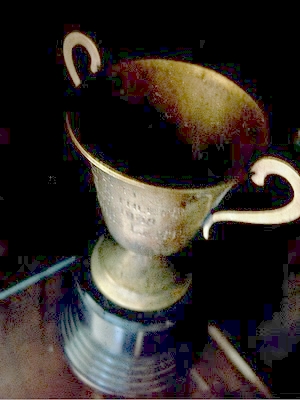
The Chalice of Pain

Father, if it is possible, let this chalice pass from me! Father, all things are possible to thee, remove this chalice from me!

Pain. We all feel pain. We all would rather not feel pain, and those in pain usually can let you know where it hurts and how badly it hurts.

Except if they have dementia.

There is a false assumption that those with dementia don’t feel pain because they often can’t articulate that fact in ways that are obvious — especially with words.

From “Pain and Dementia,” referenced above:

Over time your family member may lose the ability to speak or may not make sense when they do. Therefore, it is very important to be able to recognize behaviours or actions that indicate pain. Some of these pain-related behaviours include the following:
* frowning, grimacing, crying
* swearing, moaning, calling out, noisy breathing
* fidgeting, pacing, rigid posture
* guarding an area of their body, not wanting to move
* hitting or striking out
* withdrawing or resisting when someone is helping with personal care
* refusing food
* change in appetite, rest periods, or sleep patterns
* increased confusion, crankiness, or distress

From “Behavioural Changes”:

* Sudden changes in behaviour are important to recognize as these are often the only clue that an older person is sick, getting worse in their dementia, becoming depressed, or having a side effect from a new medication.
* Attention to your family member’s behavioural and psychological symptoms are key to improving and maintaining their quality of life.

A recent PBS Frontline program, “Facing Death,” documented the pain suffered by both family (emotional pain) and those dying from dementia and other illnesses (both emotional and physical pain.) You can watch the program at the above link. Also of great insight are the comments left by viewers.

From “What happens when elderly people die?”

…fewer than one in five people can have a peaceful end, since ‘dying is a messy business’ for which relatives are unprepared. He continues: ‘Too often, patients and their families cherish expectations that cannot be met, with the result that death is made all the more difficult by frustration and disappointment with a medical community that may be able to do no better.’

Relatives who expect aware deaths may become angry and turn their anger onto doctors and nurses when death takes other forms. Dying people often need psychosocial support, but the potential for introducing this occurs only when the dying phase is identified. This is not always possible in trajectories 2 and 3….. [2) long-term disability with periodic exacerbations and unpredictable timing of death that characterize dying with chronic organ or system failures (some cancers that respond to treatment and then relapse come into this category); (3) self-care deficits and a slowly dwindling course to death from dementia.]

After watching the Frontline program and hearing how the doctors explain the options to the families of dying patients, it seems to me that there needs to be more honesty from the medical profession about the dying process, its inevitability, and the benefits to the dying of making those patients as pain-free as possible.

Maybe, because I grew up above a funeral parlor operated by my father, a funeral director – maybe, because I sat at my father’s bedside while it took days for him to die of cancer (his mind was alert and he chose to die at home with a certain amount of pain) – maybe because I survived the excruciating pain of a breech birth and thought I had died and now I’m not afraid to die – I feel strongly that, when death is close at hand, it should be welcomed as a relief from pain and that pain (for example, of old organs failing, of agitated dementia) should be aided by pain-relief medication.

On my bookshelf is “Final Exit,” which I bought a long time ago out of curiosity about peaceful “self-deliverance” when my time comes, especially if that time comes riddled with pain.

But it becomes a lot more complicated if a form of dementia has stolen my ability to communicate my pain and my wishes. My daughter knows that I’d rather die in peace than die in pain.

In the story of the Garden of Olives, even Jesus pleaded for the chalice of pain to be taken from him. No one wants pain, although we often are willing to bear with a certain amount of it if it’s going to get better. But the pain of dying does not get better.

Somehow we need to be educated about that fact so that we hold the best pain-free interests of our dying relatives in mind.


The Deathwatch Diary (Four)

Atheist though I am, I still marvel at the awesomeness of synchronicities.

All afternoon today, as I cried and blogged and cursed, and my brother argued, and my mother lay still and panting in her hospital bed, the fat gull flew and strutted around the roof outside my mother’s window, screeching, The sound was like fingernails on a blackboard. There was no ignoring it.
So, I googled “seagull totem” and found this, which I share here:

Spiritual Messengers

Sea Gulls are messengers from the gods, especially ancient Celtic deities.

They bridge the gap between the living world and the spirit world.

Opening yourself to their energy enables you to communicate with the other side.

Sea Gull can also give you the ability to soar above your problems

and see things from above. Seeing all the different viewpoints.

Better than any fortune cookie.

And then, went I went outside to get another book from my car, I found the item in the photo below in my book bag, and I hung it on the rack on my mother’s bed that is supposed to hold IV bags.

It’s the talking stick that I and my five women friends jointly and ritually made from a root, stones, feathers, ribbon, yarn, thread, spangles, and even a golf tee. Crone magic of a very special kind.

My daughter chants to set my mother’s spirit free. And I embrace roots and wings for my own spiritual sustenance.

Such everyday magic, these synchronicities.

The Deathwatch Diary (One)

My mother’s room looks out over a roof with the HVAC and other protuberances. But over the left corner of it all, I can see the Hudson River and the Palisades. I can see it, but my 94 year-old mother can’t.

Day by day, she grows smaller in the hospital bed on the oncology floor with the patients who are at the point at which “Comfort Care” is their last best option. My mother doesn’t have cancer, but, with advanced dementia (can’t swallow) and renal failure, “Comfort Care” is her last option as well, and this is the best place for her in this hospital. (At least I think so; my brother doesn’t agree.)

I have blogged about my mother’s condition before, and you can read those posts by searching this blog for “dementia” and/or “caregiving.”

For the past ten years (which, not coincidentally, is when I began this blog) my brother and I have disagreed about the effects on my mother of her journey into dementia. What he insisted was her usual stubbornness and feistiness, I believed, from my own research, was that insidious deterioration that had begun in her brain and would end just where it is ending. I had read The 36-Hour Day, I logged onto online forums on the subject of symptoms and care. I subscribed to Care ADvantage magazine to get tips on what to look for and how to help her manage the changes I could see in her behavior and her perceptions of what was going on around her.

My brother and I brought our mother to the emergency room last Sunday, after she had refused to eat or drink for several days, was obviously dehydrated, and had begun to tune out the world. In retrospect, perhaps we should have let nature take its course, and she might have simply gone to sleep at some point and never woke up. But she seemed in severe distress — couldn’t find a comfortable position to lie or sit in, and finally, unsuccessfully, tried to sleep sitting up. She had stopped communicating and kept rubbing her legs. We couldn’t tell if she were suffering, and so we took her to the hospital,

She is sedated, now, as “comfortable” as possible during this time when her body is shutting down. Her awareness already has, except for brief and seldom moments when she is physically disturbed and then responds with wide-open, red-rimmed eyes and an unearthly howl that resonates with a primal fear.

I have slept in her hospital room every night since she was admitted last Monday, listening to her labored breaths and getting up to check her when her breathing stops for several seconds at a time. When my brother comes to stay with her during the day, I take some time and slip away to shower, change my clothes, eat something other than hospital cafeteria food, walk in the crisp fall sunshine. The time drags while I am sitting in that room with a partial view, and so I knit, read, play games on my iphone, check in with FaceBook and my son’s Twitter, check my email.

But this isn’t about me.

Or is it?

The Kochtopus: one more reason to revolt

The Kochs are longtime libertarians who believe in drastically lower personal and corporate taxes, minimal social services for the needy, and much less oversight of industry—especially environmental regulation. These views dovetail with the brothers’ corporate interests. In a study released this spring, the University of Massachusetts at Amherst’s Political Economy Research Institute named Koch Industries one of the top ten air polluters in the United States. And Greenpeace issued a report identifying the company as a “kingpin of climate science denial.” The report showed that, from 2005 to 2008, the Kochs vastly outdid ExxonMobil in giving money to organizations fighting legislation related to climate change, underwriting a huge network of foundations, think tanks, and political front groups. Indeed, the brothers have funded opposition campaigns against so many Obama Administration policies—from health-care reform to the economic-stimulus program—that, in political circles, their ideological network is known as the Kochtopus.

Read more in the New Yorker.

Like the robber barons of old, David H. Koch is a billionaire and very generous philanthropist, as though doing some good with some of his money makes up for all the bad he does with the rest of it — including the founding and support of supposed “grass roots movements” such as Americans for Prosperity Foundation. Charles Lewis, the founder of the Center for Public Integrity, a nonpartisan watchdog group, said, “The Kochs are on a whole different level….. They have a pattern of lawbreaking, political manipulation, and obfuscation. I’ve been in Washington since Watergate, and I’ve never seen anything like it. They are the Standard Oil of our times.”

The revolutionaries who held the original Boston Tea Party would never have stood for the machinations of the Kochtopus. These new Tea Partiers, manipulated by libertarians like Koch who spread disinformation and and stir up the disatisfactions of the people who will most suffer if their policies come about, are going to dismantle what is most good about this country. What these misguided citizens don’t realize is that they will ultimately suffer most, as the Kochs of this nation grind their lives to ash.

I like these comments left on a post of the blog of the Investigative Fund.

QUOTE OF THE DAY:
“I’m wondering if those who support that so-called Tea Party Movement really know where Republicans are leading them? It seems like the Tea Party rank & file are being USED by a bunch of vain, self-serving, evil, power mad, greed stricken, K-Street Con Artists. Paid for by wealthy silver spoon trust fund babies who want to turn the American PEOPLE into peasants. The scum of the earth who hide their hideous faces by using Michele Bachmann and Sarah Palin as spokespersons. SUCKERS!

Just look at their agenda items. It‘s like wet dream for Ken Lay or Jack Abramoff:
1) Repeal Health Insurance Reform
2) Privatize Social Security or abolish it.
3) End Medicare
4) Extend Bush Tax Cuts for wealthy and Big Oil
5) Repeal Wall Street reform
6) Protect all those responsible for Gulf oil disaster and future environmental catastrophes
7) Abolish or cut funding to Department of Education
..) Abolish Dept. of Energy
9) Abolish Environmental Protection Agency
10) Repeal 17th Amendment
11) Rewrite Bible and school textbooks,
12) Replace JESUS with Glenn Beck, Frank Church with Joe McCarthy…
13) After USA is destroyed by Republican Party low grade thought processes, BLAME Democrats/Liberals
14) be flunkies, soldiers and slaves for silver spoon trust fund babies like George W. Bush, Saudi Prince Bandar and the Koch Bros.

Why aren’t the mainstream media falling all over themselves to unveil the Koch behind the curtain. Sell-outs. All of them.

Health Care Reform Will Help Everybody

This is a guest post by Barbara O’ Brien, who regularly posts at The Mahablog, Crooks and Liars, AlterNet, and elsewhere on the progressive political and health blogophere, and who has earned the notoriety of being a panelist at the Yearly Kos Convention and a featured guest blogger at the Take Back America Conference in Washington, DC.

Please feel free to re-post Barbara’s piece and let me know if you do by commenting here.

HEALTH CARE REFORM WILL HELP EVERYBODY

Many Americans assume the new health care reform act will benefit mostly the poor and uninsured and hurt everyone else, according to polls. As Matt Yglesias wrote, “Basically, people see this as a bill that will take resources from people who have health insurance and give it to people who don’t have health insurance.” Those who still oppose the reform say that people ought to pay for their own health care.

We all believe in the virtues of hard work and self-reliance, but these days it’s a fantasy to think that anyone but the mega-wealthy will not, sooner or later, depend on help from others to pay medical bills. And that’s true no matter how hard you work, how much you love America, or how diligently you take care of yourself. The cost of medical care has so skyrocketed that breaking an arm or leg could cost as much as a new car. And if you get cancer or heart disease — which can happen even to people who live healthy lifestyles — forget about it. The disease will not only clean you out; it will leave a whopping debt for your survivors to pay.

And the truth is, we all pay for other peoples’ health care whether we know it or not. When people can’t pay their medical bills, the cost of their health care gets added to everyone else’s bills and insurance premiums. When poor people use emergency rooms as a doctor of last resort, their care is not “free.” You pay for it.

Another common fantasy about medical care is that the “free market” provides incentives for medical companies to develop innovative new drugs and treatments for disease without government subsidy. It’s true that private enterprise is very good at developing profitable health care products. But not all medical care can be made profitable.

For years, the U.S. government has been funding medical research that the big private companies don’t want to do because there is too much cost for the potential profit. This is especially true for diseases that are rare and expensive to treat. An example of a recent advance made possible by government grants include new guidelines for malignant pleural mesothelioma treatment developed by Sloan-Kettering mesothelioma cancer researchers. Another is a blood screening test developed by mesothelioma doctors like thoracic surgeon Dr. David Sugarbaker. The health reform act provides for more dollars for such research, from which even many of the tea party protesters will benefit.

The biggest fantasy of all was that people who had insurance didn’t have to worry about health care costs. But the fact is that in recent years millions of Americans have been bankrupted by medical costs, and three-quarters of the medically bankrupt had health insurance. And yes, insurance companies even dumped hard-working, law-abiding patriots. But the health care reform act will put an end to that, and now America’s hard-working, law-abiding patriots are more financially secure, whether they like it or not.

I am a victim of elder abuse

from “Elder Abuse and Neglect”:

In emotional or psychological senior abuse, people speak to or treat elderly persons in ways that cause emotional pain or distress.

Verbal forms of emotional elder abuse include

* intimidation through yelling or threats
* humiliation and ridicule
* habitual blaming or scapegoating

Nonverbal psychological elder abuse can take the form of

* ignoring the elderly person
* isolating an elder from friends or activities
* terrorizing or menacing the elderly person

OMG. There it is. That’s why I moved out from living with my brother and trying to take care of my mom who still lives there. I kept trying to tell him to stop, but he just kept on. I’m an elder, and that’s abuse.

And now I have to figure out how to get my mom away from him because, at 94 and with dementia and a slate of physical problems, she can’t just move out the way I did.

Boy, did I make a series of bad choices as I tried to be my mom’s caregiver. I’ve been trying to remedy my situation since, and now I have to figure out how to remedy hers.

What I find really interesting is that, while I was on an anti-depressant, I never got mad enough to fight back no-holds-barred. Now I’m off the drug and I’m really mad. And I’m fighting back.

day 3 of dementia immersion

She tries to comb her hair with her toothbrush and brush her teeth with her comb. That’s pretty much a metaphor for where my mom’s mind is. And this is my 3rd day here with her and my brother, trying to ignore his rants against my caregiving “techniques” while keeping my spirits up so that I can be of best use to my mom.

Every once in a while she does have a lucid moment. Soon after I arrived, she looked at me, smiled, and then started to cry “I’m so happy happy to see you!!” Several minutes later she asked me “What is your name?”

Sometimes she calls me “Pani,” which is the Polish equivalent of “Mrs.” In those cases she knows I’m someone who helps to take care of her but forgets who I am. Sometimes she calls me “ciocia,” which means “aunt” in Polish, and she thinks I am one of her many aunts (all long gone) whom she knew as a child. Sometimes she hugs me and says “You are my mother.”

But mostly she vocalizes quick pants of “a ah, a ah, a ah….” for hours on end, refusing to take even a tylenol.

I am only here for a while once a month. My brother, who has CONTROL but no real self-control, keeps her with him and does the best he can by himself. They both need more help, but he won’t bring any in.

I’m doing my best to keep my reflux and back spasms under control. How long I last here depends….

I keep reminding myself that she won’t live forever, even if right now it sure feels like it.

While she’s napping, I’m going to wash my hair.

independence

There is a lingering scent of bug spray throughout the house this July 4, left over from yesterday’s cook-out and trek down the street to watch the fireworks. I had the option of not hanging out in the 90 degree heat with the forty-something-aged parents and their young kids and not standing around in the mosquito and Japanese beetle invested night with the hundreds of others, necks craned to the sky. I chose to hang out in my own cool space, making periodic appearances to gather up my food and drink and interact a bit with the guests.

Such is the privilege of age — especially in my situation, where I have few responsibilities to anyone but myself. (Except, of course, my 94-year-old demented mother, whom I will visit in a few days to help with her care.)

It is Independence Day in another way for me. For the first time in some 25 years, I am off an anti-depressant. It served it’s purpose, and I was done with the lack of depth of feeling that is the both the benefit and the curse of those meds. It took three months to wean myself off, and I am seeing a counselor to help with the transition, but it’s worth it.

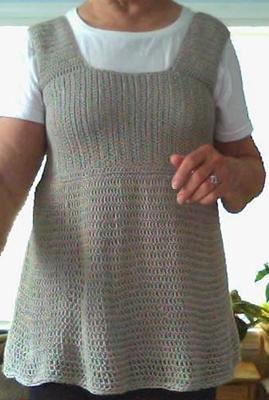
I’m writing more, feeling more, doing more. I’m almost done with the three-dimensional wall hanging that I’m creating for this virtual exhibit. I’m quite pleased with the result, and I have ideas for more such projects. And I’ve begun a sweater for my daughter like the one below I made for myself, but in another color.

I’m even feeling more sympathy for my poor mother, and, in a new strange way, I’m looking forward to spending some time with her, trying to ease her weary mind.

I am thinking a lot about being the age I am (70) and what I want for myself, which is seeming to be so very different from what I wanted even a dozen years ago. I am trying out some alternative ways to relieve the pains of joint and spine problems, and they seem to be working.

Today is Independence Day, and despite the turmoil and despair in so many other parts of this world, in this small space that my life takes up, it’s a good day.

Yes, it’s a good day for singing a song,
and it’s a good day for moving along
Yes, it’s a good day, how could anything go wrong,
A good day from morning’ till night

Yes, it’s a good day for shining your shoes,
and it’s a good day for losing the blues;
Everything go gain and nothing’ to lose,
`Cause it’s a good day from morning’ till night

I said to the Sun, ” Good morning sun
Rise and shine today”
You know you’ve gotta get going
If you’re gonna make a showin’
And you know you’ve got the right of way.

`Cause it’s a good day for paying your bills;
And it’s a good day for curing your ills,
So take a deep breath and throw away your pills;
`Cause it’s a good day from morning’ till night

Delayed Gratification

We were supposed to leave for Maine today, but my grandson had a stomach bug and fever yesterday. He seems fine today, but we gave him another day home just to make sure.

It’s been a while since any of us have been able to go away for a whole week, and we are all looking forward to the ocean and the nature preserves and the deck on our cottage that looks out over an estuary. My grandson and his dad will fish, and my daughter and I will just veg out.

Time is passing too quickly for my liking and taking with it too much of the physical capacities I’ve always taken for granted. Degenerative disc disease is not uncommon for people my age, but mine is worse than normal. There’s not much I can do at this point — eat healthy, stretch….

I remember that my mother had a chinning bar attached near the top of an open doorway, and she would hang from it by her hands several times a day. I think it helped a lot with her spinal problems, and now I have one here. When I hang from it, I often can hear the pops of my spine decompressing.

I spent a little time online last night searching for ways to decompress the spine. Hanging by your hands from a bar is one of them — one of the least expensive and easy to use.

I am lazy and things I wanted and/or wanted to do always came easy to me. Notice I said “things I wanted.” Maybe I didn’t want the things I didn’t want because they didn’t come easy to me.

I was never one to delay gratification — whether it was eating chocolate or buying a new pair of jeans. This is something I am learning to tolerate now in my elder years.

I think of my dementia-plagued mom, who seems to be able to be gratified by so little — a globular gourmet lollipop that she can suck on for hours, a simple song that I make up as I go along.

Tomorrow, Maine, and some gratification for me. In another few weeks, I make the journey to try to give my mother some little gratification. (I wish I could take another vacation after that!)

Meanwhile, I am continuing to see a chiropractor for thoracic spine therapy, since the muscles are still pretty sore and in spasm from my fall off the bed at my mother’s a little over a month ago.

I will probably never delight in Salsa dancing again. And that’s too bad, because I always found the movements and the music very gratifying.