What to tell your kid about dying
when you don’t believe in heaven.

Your eight-year old can’t go to sleep because he’s crying so hard. He’s crying so hard because, he says, he doesn’t want to ever die and he doesn’t want anyone he knows to ever die because he doesn’t want to be alone.

You don’t really believe in “God,” and don’t believe in heaven. You’re not religious, and the Golden Rule is about the closest you come to embracing any doctrine, although you try to pass along a moral and ethical code that you hope he understands and continues to live by.

But what about “after?” What about after this life? What do you tell your eight-year old that will calm his fears without outright lying?

What you do is write a book that explains who and what we are in a way that will address his fears yet still be in the realm of what might actually and scientifically happen. ( After all, Carl Sagan thought so.)

And you call this book Spark.

Go over online and read through Spark — and see if it’s the answer you’re looking for.

The Whole Truth

We never really know the whole truth, we ordinary people who try to survive in a context over which we have no control. We try to follow the trail of newsworthy events, forgetting that news and histories are written — well, by whoever writes it all up.

And, sometimes acknowledged fiction writers, creating a fictional story line, seem to come closer to the truth than what we are fed as the truth.

The Whole Truth, David Baldacci’s 2008 international intrigue novel, might have a story line metaphorically closer to the truth than what we are being fed by the “news. There is a character that might well be an (only slightly exaggerated) embodiment of the Koch Brothers and a story line that takes the premise farther than Wag the Dog.

One commentary piece that everyone should read that accurately and succinctly gets to some of the bottom-line truths about what’s happening in America today is Ronni Bennett’s (Time Goes By) post, “Something’s Happening Here.”

She supports the following statement with factual links and graphs:

Although citizens of the U.S. are not detained, imprisoned, tortured, executed or shot in the streets as in some Arab countries, we are nonetheless oppressed. Our government, in long-time cahoots with the corporate elite, started decades before this current financial crisis to steal for themselves all but the shirts on our backs.

And, in addressing the incendiary situation in Wisconsin, she says what I hope lots of us are thinking:

If I am right about what they and their supporters are doing, the protests will spread throughout the land, particularly when the weather warms up in a few weeks. Massive street protests are the only power we the people have left against the corporate/government plutocracy.

God, I hope I’m right, that these people are the vanguard of what is coming. If so, it will be a long and bitter struggle against Mr. Jones, but I don’t see an alternative. We must fight back even if, in the end, we lose.

They’re doing it in the Middle East, setting a standard for the value of human rights and freedom,

Of course, in Baldacci’s novel, there’s a “hero” who determinedly figures it all out.

But we have no heroes. We only have ourselves.

The Real Wonder Woman
vs David E. Kelley

If you’re not a member of the fandom community, you probably don’t know about the growing criticism of NBC for choosing David E. Kelley to write the script for a new series about Wonder Woman. (Just Google “Wonder Woman David E. Kelley” and you’ll find out more than you really want to know).

As a more than half-century fan of Wonder Woman, and as a shorter term fan of Kelley’s previous tv scripts, there’s something I want to say.

It’s a matter of “awe.”

Kelley’s female characters, such as Allie McBeal, have been criticized for being anti-feminist. I maintain that those characters are not meant to be “archetypes” or “heroes.” Neither inspiration nor role models, rather they emerge from some small portion of female idiosyncrasies with which many of us identify and also recognize as not necessarily the best of what we are. Actually, his male characters develop the same way, portrayed as flawed and human in ways that make us smile with poignant understanding.

But that’s not what Wonder Woman was ever meant to be. Wonder Woman was never meant to be fully human. As I blogged once before and quoted from here:

From her inception, Wonder Woman was not out to just stop criminals, but to reform them. On a small island off Paradise Island was Transformation Island, a rehabilitation complex created by the Amazons to house and reform criminals.

Armed with her bulletproof bracelets, magic lasso, and her amazonian training, Princess Diana was the archetype of the perfect woman from the mind of her creator, William Moulton Marston. She was beautiful, intelligent, strong, but still possessed a soft side. At that time, her powers came from ‘Amazon Concentration,’ not as a gift from the gods.

Wonder Woman’s magic lasso was supposedly forged from the Magic Girdle of Aphrodite, which Queen Hippolyta (Wonder Woman’s) mother was bequeathed by the Goddess. Hephastateus borrowed the belt, removed links from it, and that is where the magic lasso came from. It was unbreakable, infinitely stretchable, and could make all who are encircled in it tell the truth.

That was the Wonder Woman who inspired me as a 7-year old who felt that she never did fit into her family of origin, the pre-teener and teenager who yearned for a role as an adult that didn’t fit into the 50s mentality.

While Allie McBeal made us smile because we see part of ourselves in her antics, Wonder Woman makes us dream about what we might still become. Male or female, we need awesome and inspiring mythologies to propel us out of the ordinary and problematic parts of ourselves that characters like Allie so touchingly reflect.

Kelley’s “Harry’s Law” starring Kathy Bates is my new favorite show (even though the part was originally written for a male.) But Harriet is not an archetype either. She’s a very specific kind of individual with very human personality traits. We might find her inspiring, but not really “awesome.”

We females need Wonder Woman as the awesome myth she originally was intended to be — connected to other mythic females on Paradise Island more than she is to the mundane human world in which she has to find a place. Her struggle is to fulfill her destiny while still finding a way to make and enjoy her place in the everyday world.

Because isn’t that what so many of us still feel is our psychological destiny — to feel the power of our mythic history and to use that power to make the world a better place for others and for ourselves?

Maybe David E. Kelley can write Wonder Woman the way she deserves to be written. Maybe. But I can’t help feeling that Joss Whedon (who understood why we were awed by his Buffy) would have been a much better choice.

Please, Mr. Kelley, don’t dilute the awesomeness of Wonder Woman. She doesn’t deserve it. And neither do we.

The History of the Universe
as Told By Wonder Woman

The production of an independent film, titled above, depends on the filmmakers raising $10,000 by the end of the month. As a Wonder Woman fan since 1957, I’m looking forward to seeing this film, and I even donated. You can too.

This is how the filmmakers describe their project:

The goal of the film is to explore how female heroes have fared in popular culture. We’re using Wonder Woman as the central figure in this story, as she’s the rare example of a female hero who doesn’t require rescue and determines her own actions and adventures. The film not only serves as an inquiry into our evolving values about women as agents of strength, authority and leadership, but also reminds us of our common need — no matter our gender, race, class or sexual orientation — for stories that tell us we can all be heroes.

You can donate as little as a dollar or as much as you want. $35 or more gets you a free signed DVD of the completed movie. Watch the trailer. You’ll be hooked.

a box of books

Every time I move, I get rid of a bunch of books by donating them to the local library. There’s a box of books, however, that I keep hauling around with me.

As I’m rummaging around in my stored stuff looking for memorabilia for my college reunion website, I unearth that old box.

One of the books it contains is actually two copies of the same book: a translation of the Tao Te Ching by Gia-Fu Feng and Jane English. It’s been years since I’ve looked through either of them. There is one section that I memorized because it is so meaningful to me. I open the book, and there it is:

EIGHT
The highest good is like water.
Water gives life to the ten thousand things and does not strive.
It flows in places men reject and so is like the Tao.

In dwelling, be close to the land.
In meditation, go keep in the heart.
In dealing with others, be gentle and kind.
In speech be true.
In ruling, be just.
In business, be competent.
In action, watch the timing.

No fight: No blame.

Good advice.

why I haven’t been blogging

Talking much about oneself can also be a means to conceal oneself.
— Friedrich Nietzsche

While I believe that the above quote is true, that’s not the reason I haven’t been blogging here.

The main reason is that I’ve been setting up a WordPress.com blog for my 50th college reunion as a way of generating some nostalgic interest among my former classmates — in hopes of getting them to attend. The reunion isn’t until the Fall, and the site won’t go live until May, but I’ve been brushing up on html codes so that I can add a little pizzazz to the look of the site. I don’t have a great design eye, but, using a simple WordPress template as the basis, I’ve been able to figure out how to insert lines to break sections and how to format a table within a page, and how to do some other tweaking that I wanted to do. I actually like doing this stuff, and hours can go by before I notice that my butt’s numb from sitting so long.

The other reason is that I’m figuring how to knit a sweater on a bias. I have a pattern, but I’ve had to change the stitch count because I’m using a different yarn. I’m sure getting my math-phobic brain some exercise.

Then, of course, there’s my FaceBook games of Scrabble, Lexulous, and Wordscraper, which I also do for brain exercise. And lately I’ve been doing an online picture puzzles as well.

I’m reading mystery novels and listening to an unabridged audio version of The Help, recommended by a friend and downloaded from my library. The narrative is totally engrossing, pulling me into the lives of everyday people whose lives were affected by the Civil Rights turmoil of the early 60s.

I just finished reading (for a book club I hope to join later this month) Home Repair, which has a story line very close to my own life’s narrative.

It is definitely great to be retired so that I can have this fun playing.

I did notice, however, that the taxes on my Social Security went up. Now, that doesn’t make for much fun.

I have to remind myself that it could always be worse.

Will the 9/11 First Responders Law Do the Job?

[Note: The following is a guest post by Barbara O’ Brien, whose blogging at The Mahablog, Crooks and Liars, AlterNet, and elsewhere on the progressive political and health blogophere has earned her the honor of being a panelist at the Yearly Kos Convention and a featured guest blogger at the Take Back America Conference in Washington, DC. Her piece here is just another worrisome indication that we must keep fighting the opponents of health care improvement on all fronts.]

In the final days of the 111th Congress, the James Zadroga 9/11 Health And Compensation Act, also called the “9/11 First Responders bill,” finally passed. The Act will provide medical monitoring and care for those who worked on the smoldering ruins of the World Trade Center after the 9/11 attacks, as well as for many who lived and worked nearby.

However, at the insistence of some senators, the final bill was considerably watered down from what it had been originally. More than $3 billion in funding was cut from a previous version of the bill, for example. Will the revised bill still do the job?

When the Senate passed the bill, initial news reports said that the monitoring and health care program would end after five years. However, the actual language of the bill provides for funding limitations for monitoring and health care after fiscal year 2016, which suggests the program might continue if Congress authorizes funding for it.

The monitoring issue is particularly critical. The collapse of the mammoth World Trade Center towers released thousands of tons of toxic particles into the air. For many weeks after the attacks, people who lived and worked in lower Manhattan and Brooklyn suffered burning eyes and hacking coughs from the foul air. Yet at the time, the federal government and the city of New York assured people the stinging fumes were not dangerous, just unpleasant.

Several days after the terrorist attacks, some independent researchers slipped past the police barricades to take samples. They found the air contained more than twice the number of asbestos fibers considered “safe,” as well as deadly levels of benzene, dioxin, and other toxins.

Why should people exposed to the toxins continue to be monitored? Asbestos in particular is a very slow killer. It has been well documented that the first symptoms of the deadly lung cancer mesothelioma may not show up for 20 to 50 years after exposure to asbestos. But early detection should prolong lives and make mesothelioma treatment and other medical care more effective.

The final bill does close the Victims Compensation Fund in five years, which is separate from the health monitoring and care part of the bill. It also provides for more stringent monitoring of benefits, which might make it harder for people to get into the program.

Today — more than nine years after the attacks — many rescue and recovery workers are suffering deteriorating health. A study published in April 2010 in the New England Journal of Medicine found that New York City firefighters and emergency workers continue to suffer from severe and persistent lung problems because of their exposure to the World Trade Center debris. Some of these 9/11 heroes already have died.

Firefighters, police officers, and other responders who had been begging Congress for help for nine years called the passage of the bill a “Christmas miracle.” Let us hope the final version of the bill will do the job.

floating into February


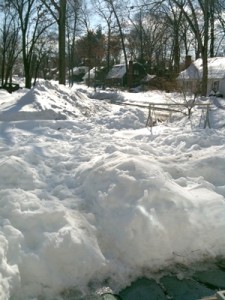
This is the kind of day for skiing or snowshoeing or snow-fort building. But I don’t do any of them. I can’t seem to even walk very far these days.

But today, with the sky a clear blue and a sun that has finally left the falling snow behind, I bundle up and get myself outside for the first time in weeks. I take a short walk around a few blocks — just about as much as my joints can take today.

When I come back to the house, I haul out a stool and sit on the small porch. I close my eyes. For a moment I am back in my babyhood carriage — the old kind from the 40s, with an oil cloth cover that rolls up to my chin, so that I am warm and snuggly inside, even though my nose is cold. The sun is warm and bright on my closed eyelids. I want to be a child again.

I think of my mother — how young and happy she was when she pushed me in that carriage — how disappointment and dementia drained from her spirit what was the best of her. I think of her because her 95th birthday would have been this month; she would have made it had she lived for three more months. But it’s just as well that she didn’t; those months would have only extended her hell on earth.

I could sit here all day, pretending. But I have a math challenge to confront — figuring out how to use a sweater pattern I like but using a different weight yarn and different size needles. It’s all algebra, but math-challenged that I am, I have to work myself up to grappling with setting up the equations. I can’t seem to keep my body in shape, but I try to do so with my brain.

I do have to deal with my body, though, despite the back problems. I’m hoping I can try the “chair yoga” this week at the senior center in town — that is if it’s not canceled again because of a another snow storm. And I’ve begun firing up my wii around 4 p.m. every day just to do some balance and aerobic exercises, which I seem to sorely need.

We are all waiting for spring. But for today, I’ll take the sun on snow.