
Like every human on this planet, my heritage traces back to the heart of Africa, from where the original homo sapiens emerged around 100,000 years ago.
Somewhere around 40,000 years ago, their descendants descended on what eventually would be the nation we now know as Poland. Since the time of these early forbears, the land that was considered “Poland” shrank and expanded depending on the whims of glaciers and governments. Pretty much land-locked except for its limited access to the Baltic Sea, Polish land has been traipsed over, lived on, and fought over by tribes and nations from the Turks to the Celts. The 19th and 20th centuries, alone, saw Poland’s boundaries recede and expand drastically as various histories and wars played themselves out.
While I know that America has claim to the title of “melting pot,” pre-historic Poland has to come close because of the hundreds of different peoples who settled there at one time or another, coming upon its central location accidentally or on purpose. So, even though I can trace my bloodline back through several generations of “pure” Poles, the truth is that I have in me genetic traces of countless races, leading back to that elusive “Mitochondrial Eve.”
Why I’m thinking about all of this is that I’m taking a class in Polish language and culture to help me remember how to converse in Polish. I have no immediate reason for doing that, except that it’s free at the Senior Center, and relearning the language is helping me to exercise my brain.
I have never been very good at just sitting in a class and listening. I like to participate. So, I offered to do a session next week on the traditions still alive in Polish culture today that have their roots in that land’s pre-history. (Of course, that means “pagan,” but I didn’t use that word in my offer to do the session. All of the other students seem to be Catholic, and I didn’t want to use language that would turn them off.)
For anyone who is interested, there are a very few websites that deal with Polish/Slavic pre-history. This is the best of them.
More than a dozen years ago, I stumbled upon a wonderful site explaining the pagan origins of various Polish folk customs and chronicling the Polish pagan pantheon and magical symbols. I printed out all 80-something pages of information from that now-defunct website, and I am so glad I did because I would have to track down a ton of books to compile it myself at this point. I’m thinking that I probably saved it on my old computer but somehow lost track of that document.
Growing up Polish in America (as did the other students in my class), what I was told about Polish history made it seem as though it all started with the the conversion of Poland to Christianity back somewhere around 990 A.D.
In the course of the Christianisation of Europe in the Early Middle Ages, the Christian churches adopted many elements of national cult and folk religion, resulting in national churches like Latin, Germanic, Russian, Armenian, Greek and so on. Some Pagan ceremonies became modern holidays as pagans joined the early church.
It just goes to show you — children are told the history that their “responsible adults” want them to believe. But there’s always more. Always more.
Do zobaczienia.

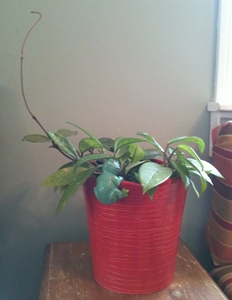 Some 25 years ago, a friend gave me a clipping from her Wandering Jew plant that she had grown from a clipping a friend had given her.