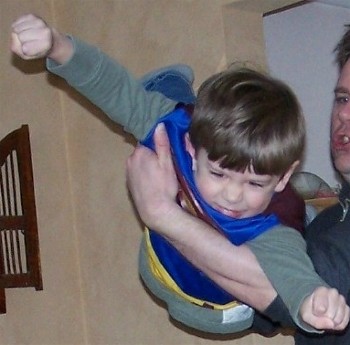
misty moisty morning

One misty moisty morning
when cloudy was the weather
I chanced to meet an old man
clothed all in leather.
He began to compliment
and I began to grin.
How do you do?
And how do you do?
And how do you do, again.?

window.JPG
It is that kind of morning, and I sit by the window outside my mother’s bedroom and think of that nursery rhyme I used to sing to b!X when he was a toddler. I don’t know where we first heard it. On Captain Kangaroo, I think.
This is the kind of day I always loved as a kid. I could curl up on the couch and read and nap all day. I could just lie there and let my mind wander, create those magical lands to which I could escape.
Although it is misty and moisty, it is not that kind of day here.
My mother had a bad night last night, tossing, turning, wrapping herself in her blanket. A hint of shroud.
She tends to sleep on her side, and she puts pressure on the nerve bundles at her shoulders. Her bones are fragile, and we can’t help wondering if she fractured something. She hurts at that spot at the tip of her shoulder and down her arm. We prop her up in bed so that she can lie on her back, put pillows under her knees. Her hands and feet are cold, and we turn on the electric blanket. I heat up the mirowaveable packs I made (filled with millet) and place one on each shoulder. We give her tea with honey. I think she’s dehydrated. She falls asleep.
I’m supposed to start my exercise program at Curves tomorrow. It’s the one thing I really need to do for myself. I really need to do that.
Her breathing is so shallow that I have to watch very closely to make sure that I can see her chest rise and fall.
I sit by the window on this misty moisty morning. The snow has melted everywhere but on the lake. I notice that we have a few new finches stopping by the feeders. The squirrels, annoyed that we have put a baffle above the bird feeder, have taken to climibng up the window screen to get to the suet cage. I look up and one is splayed, belly to my face, across the screen. They are supremely persisent.
Yesterday, I started going through my seed packets, hoping to get a head start on spring.
Today I sit by the window and envy the persistence of squirrels.
I hear a noise and see my mother standing in the doorway. She looks better. She has the persistence of squirrels.
Not relevant to anything here, today is the Ides of March.

odd news bits from Harper’s Tuesday

Check here for links to sources and for more scary news.

When accused of stealing lingerie from a shop, a German man told a court that his elf alter ego may have been to blame,[BBCnews.com] and a woman in Boston was suing Planned Parenthood and two doctors for childrearing costs after finding out she was still pregnant following an abortion.[Boston Globe]

A Pennsylvania mother pled guilty to swinging her infant son like a bat to hit her boyfriend,[AP via CNN.com] and after stabbing his wife multiple times a Connecticut man gave the knife to his son and said, “Now you stab mommy.”[AP via CNN.com]

A study claimed that girls shown videos of women suffering from eating disorders became more likely to view these women as “very pretty” and thought it would be “nice to look like” them,[Reuters] and low-dose estrogen and progesterone birth control pills were reported to reduce ovarian cancer risk.[Reuters]

The Navy was researching an electromagnetic beam that would penetrate walls and cause people to fall over and vomit.[Wired.com]

A human rights group in Israel accused the country’s army of using Palestinians, including an 11-year-old girl, as human shields,[BBCnews.com] and the Israeli ambassador to El Salvador was recalled after police found him in the embassy, drunk and naked except for bondage gear, with a rubber ball stuffed in his mouth.[BBCnews.com]

A man in England who had demonstrated against cartoons of the prophet Muhammad was found guilty of soliciting murder.[BBCnews.com]

The United Nations announced that Afghanistan’s yield of heroin poppies rose 25 percent last year.[BBCnews.com]

Osama bin Laden turned fifty.[Reuters via CNN.com]

real women have….

Yes, I know. The expected subsequent word is “curves,” and I was going to post about having an appointment tomorrow morning to sign up at “Curves for Women” so that I can get myself on an exercise program.
But that was before I checked over at a blog from Saudi Arabia written by an American woman who lives there. If you haven’t found Sand Gets In My Eyes yet, you’re missing out not only on some excellent writing, but even more important, on a perspective on that country that is both honest and personal.
Her post Is Phyllis Chesler Right? is infuriating because it’s so honest, so correct (although not politically), and links over to an even more infuriating article in the Times Online by Chesler entitled How My Eyes Were Opened to the Barbarity of Islam.
Now, I have been a fan of Chesler since I read Women and Madness at a time in my life when I was both mad/angry and wondering if I were going mad/crazy. That book helped to launch me into the heart of feminism.
Just as I can’t understand how savvy, smart women can tolerate the demeaning attitude toward them from the Catholic and other “Christian” churces, I have never been able to understand how anyone with an ounce of humanity in them keep finding excuses for the way women are treated in so many of the Islam-based cultures. I find it infuriating.
And so do Lori of Sand in My Eyes and Chesler of the long list of
publications challenging women to stand up and men to wake up.
I’m not going to quote from either of them here because both of their pieces (see third paragraph above for links) should be read whole.
I continue not to understand why the most “religious” people totally ignore the Golden Rule.

goldenrule.jpg

Heroine from the Hellmouth

I’m still a big fan on hers, even though her television series ended three years ago after a seven year run.
Buffy slayed more than vampires; she destroyed gender stereotypes and earned a well-deserved spot on the altar of feminist archetypes..
Today is the 10th anniversary of the series premiere, and b!X has a timely (it is Women’s History Month, after all) post about the legacy left by Buffy the Vampire Slayer that includes the following:

“It’s about power,” proclaims The First Evil in the seventh season’s premier episode. By the time the season, and the series along with it, comes to an end, Buffy proclaims to a room full of girls denied such power by long-dead men who were afraid to fight their own battles: “I say my power should be our power.”

And suddenly, the series breaks open its long-standing metaphor, of Buffy representing any girl or woman working her way to her own particular power, and shows the point of it all more blatantly and unapologetically than it ever had before.

Buffy the Vampire Slayer always was about one character saying to girls and women in her audience, “My power is your power.” Fitting, then, that in the end the series found a way, within its own mythology, to dramatize for us what that meant. To make her power their power.

67 is not an important number

Some people think that 6 is an important number. And 7 is also an important number. But 67 doesn’t mean anything except to me. I will be 67 on Sunday.
67 years on earth, an earth that changed drastically over those six and a half plus decades. I’m sure you’ve gotton those emails detailing the way we were back in those olden days — before television, before polio vaccinations, before wireless telephones…..
A couple of years ago, I read a piece in the Albany NY newspaper that chronicled the history of my generation from a perspective that many share. I blogged excerpts back then, and I have gotten permission from the author to post the article here in its entirety. The author left out some things I might have put in, and put in some things I, personally, would have phrased and emphasized differently. I share it here because I think many of my generation feel the way this author feels about the past we have all shared.
This fall, I will be going to my 50th (now there’s a significant number) reunion of my graduating class from a co-ed Catholic high school. From past reunions, and from the growing list on Classmates.com, I can see that I — atheist, divorcee, vocal feminist — will most likely be the ranking odd ball.
For what it’s worth, I think they would share the following perspective on the past 67 years:

2005: My Generation is Going Gold
by Silvio Laccetti
Professor of Humanities at Stevens Institute of Technology, Hoboken, NJ

We are the smallest generation. Once called the silent generation, we are the pivotal generation of the last 60 years. We are the Rock’ n Roll Generation, born from 1940 through 1945. My generation. This New Year, 2005, the first of our number arrives at the golden age of 65.

Sandwiched between the Greatest Generation and the Baby Boomers, we occupy our own high place in America’s social history. We have served as foundation builders in key areas of American life, and we have cemented the social structure of the last 35 years. Our generation is recognized by many names.

Of course, as the Rock ‘n Roll Generation, we discovered and popularized the music that radically changed popular culture. In the early 50s, proto-rock ‘n rollers found the moondog music of black artists on obscure R&B stations. “Rock” became a cultural attitude, infusing the arts, theatre and even politics. We were the first modern generation of rebels, albeit rebels without a cause. We said rock and roll would never die and, for better or worse, it hasn’t.

Clearly, my generation is also the Atomic Generation, closely identified with the 1950s and their epochal changes. Domestic joy and tranquility contrasted with apocalyptic visions of annihilation.

On November 1, 1952, the U.S. exploded the first H bomb. Soon afterwards, fantasies of total destruction were regularly projected in film and slide shows in school auditoriums throughout the land. I can still remember the fear that gripped us while watching endless replays of that nuclear detonation. Goodness gracious, great balls of fire!

Luckily our trusted teachers taught us what to do. We learned to duck!

The Atomic Age was the most fearful aspect of a more generalized pathology — continuous, unpredictable Cold War. Brutal, atheistic communists ravaged our generation’s reality. To combat this threat, most institutions, including Hollywood and even the government, itself turned to the only help left- God.

The first Cold War Generation learned more about religion through popular culture than they did by any other means. GOD was inserted in the Pledge of Allegiance in 1954. Biblical themed epics bounded at the movie shows and nobody objected. The last significant one of this genre- for us- was titled The Greatest Story Ever Told (1965). Everyone seemed to know He had the whole world in His hands.

As we matured into adolescence we became the Space Age Generation. When the Soviet Union beat us in the space race with their launch of Sputnik in 1957, we were to be the vanguard protectors of the free world. We began preparing for careers in astronomy, physics and rocket science (Science!) math and, of course, engineering. Excitement and challenge were in the air.

We reached for the moon and we helped the nation to get there. We seemed to be reaching for God, climbing a stairway to heaven. But down that stairway had come the Roswell aliens, and others from the dark side of the moon were on their way.

To be sure, not all our generational foundations were unsettling. We were the TV Generation, enjoying a pleasant life in black and white. We were learning to live vicariously as most people do now through technology.

In one special institution (for boys only at first) we lived actively and vicariously as well. We were the founding generation of Little League. Put me in coach, I’m ready to play.

Because we passed through so many mini-revolutions we were also the cement that binds much of our society together. We went from the 78 rpm record to the DVD recorder disc, from the typewriter to the Palm pilot.

Passing through these developments makes my generation a source of wisdom which is a valuable social cohesive never to be overlooked by younger people. We have been and are that proverbial bridge over troubled waters.

My generation was gut-wrenched into maturity in November, 1963 during the long days of national mourning for President Kennedy. Mature, melancholy and morose, our momentum as generational leaders of change quickly ebbed. Our place was taken by Baby Boomers all too ready and too eager to begin their work.

If 1963 was a year of innocence lost, 1965 was the pivotal year for America and our last year as “leaders of the new generation”. In truth, we were ready to abdicate. The face and course of America was to change forever in that fateful year.

A short list of events in that single year includes: the great escalation to war in Viet Nam; the shocking urban riots in Watts; a renewed but combative Civil Rights movement; Urban Renewal; the new Immigration Act. Out with the old, in with the new!

In New York City, the last great World’s Fair closed its gates and in November, the lights went out in the city. My generation was not the one that turned them on again.

Forty years later, it’s 2005 and most of us are staying alive (oops). Thanks to new attitudes toward seniors and second careers, and with continued help from medical advances we remain an undeniable part of America’s future. As veterans of four decades of change in which America became the sole world super power we still have much to contribute. We will not fade away.

Maybe 67 isn’t an important number, but along the way during these 67 years, I have lived through some identity-challenging events in both the Big Picture and LIttle Picture. Unlike some, I have shed my skin several times along the way, re-inventing myself to suit my needs at the time.
And so it goes.
these nine women

Ida B. Wells Barnett, antilynching activist
Mother Jones, an advocate for coal miners
Dr. Alice Hamilton, a proponent of workers’ rights in the chemical industry
Frances Perkins, who helped establish Social Security
Virginia Durr, who fought to end poll taxes
Septima Poinsette Clark, an advocate for the rights of black voters
Dolores Huerta, farmworker organizer
Dr. Helen Rodriguez-Trias, a reproductive rights activist
Gretchen Buchenholz, a child advocate
It is Women’s History Day in Women’s History Month.
As I listened to my NPR station driving back from my daughter’s yesterday, the host of one of the programs was interviewing Al Gore’s daughter, Karenna Gore Schiff, the author of Lighting the Way: Nine Women Who Changed Modern America
Schiff had chosen the nine women she wrote about because these women not only had a strong sense of women’s rights and a devotion to making social change; while they were trying to change their world, they aslo took care of family and friends.
As my grandson revs up to start Kindergarten in the fall, I think of all of the children whose parents can’t/don’t have the time, resources, energy, expertise, will (or all of those) to help their kids love to learn even before they start school.
Gretchen Buchenholz has devoted her life to to helping those who need a helping hand, especially kids.
In an article Karenna Gore Schiff wrote for Readers Digest, she tells about meeting Buchenholz for the first time:

After I married and moved to New York, I began hearing about Gretchen Buchenholz. People told me how this native New Yorker and mother of six had worked on behalf of needy and marginalized families for years in the city, and how she was a hands-on, skilled advocate. She did everything from buy groceries for homeless families to start schools for children. In 1974 she founded Merricat’s Castle, a nursery school that opened its doors to kids of all racial and economic backgrounds, the able-bodied as well as those with disabilities or terminal illnesses. (It’s still going strong.)

She also ran a soup kitchen for the homeless and worked on behalf of children born with HIV, helping to get the care they needed from the moment they tested positive. I thought, I want to meet this person. Still, I felt a little intimidated. What would she be like? She was a pioneer, after all. And what had I really done in my own life to compare?

Having been brought up to value public service as well as family, Schiff understands the motivation of women such as those nine above to reach out and mother the world. In her Readers Digest piece, she says:

Growing up as the daughter of Al and Tipper Gore, I’d always known my work would involve helping others in some way. When I was 11, my mom, sisters and I were walking in downtown Washington, D.C., when we passed a group of homeless people in tattered overcoats, sleeping on grates. My sisters and I asked my mom why people were out on the street like that. She replied, “Actually, we should try to help them,” and then marched us over to a nearby soup kitchen to volunteer. The idea of becoming part of the solution to a problem stuck with me.

I, who for the time being, am constrained by caregiving, wonder what small thing I might be doing, the effects of which would be felt beyond this mountain. I guess I’ll never know.

Respite

That’s what I need, and that’s what I’m going to get — two days two nights visiting my four and a half year old grandson. Leaving tomorrow morning to include shopping at Lee Outlet in Massachusetts, where there’s no sales tax on clothes.