I got interested in reading and in mythology by reading comic books. Particularly Wonder Woman. And that was back in the 1940s, before the whole superhero thing really took off. My two kids grew up with comics. In the 1970s, my son had the expected monumental comic book collection, which I made him sell off when he went off to college. (Argh. Not very smart of me, since he had some first printing editions which became very valuable to collectors.)
Comic book heroes like Superman touted good ol’ American values: “Truth, Justice, and the American Way.” Other cultures have similar values, however, and the time has come to create heroes that can demonstrate values that are common to all humane cultures.
The 99 is the brainchild of Naif al-Mutawa, and he recently gave a talk at TED about the origin of the idea. The gist of it is that he was inspired by the positive values imparted by the heroes of Marvel and DC comics. He wanted to create a more multicultural team of heroes who would extend those positive messages to people outside of the U.S., and expose American audiences to a more culturally diverse team of heroes. So here is a New Yorker—inspired by an American art form, who sees no difference between his Muslim and his American values—being vilified by the conservative noise machine for wanting to export those values around the world.
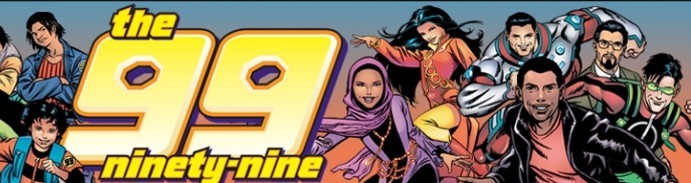
President Obama made a special mention about THE 99 superheroes and its creator, Dr. Naif Al-Mutawa, in his speech given recently at the Presidential Summit on Entrepreneurship held in Washington. The President commended THE 99 for capturing the imaginations of young people through the message of tolerance. Entrepreneurs from all over the globe are attending the summit, including Dr. Naif Al-Mutawa, creator of THE 99 superheroes.
Go to the The 99 website to see an animated preview of the series and learn about the diverse group of 99 heroes whose combined adventures just might do more for multicultural tolerance and understanding among young people than any textbook on the subject.
You can also download a comic book that tells of their origins. How cool is that!
